July 2018
URL: http://www.kingcorn.org/news/timeless/GrainFillStress.html
Effects of Severe Stress During Grain Filling in Corn
R.L. (Bob) Nielsen
Agronomy Dept., Purdue Univ.
West Lafayette, IN 47907-2054
Email address: rnielsen at purdue.edu
Twitter: @PurdueCornGuy
 ield potential in corn is influenced at several stages of growth and development. Ear size potential (number of potential kernels) is determined quite early, from about leaf stage V6 to V15 (knee-high to about shoulder-high). The next influential period for the corn crop is pollination. The period following successful pollination and finishing at kernel black layer is defined as the grain filling period in corn and represents the final important yield determination period. Grain fill stages in corn are described in an accompanying article.
Perfect conditions for ear size determination and pollination can be negated if severe stress occurs during the grain fill period. Yield loss during grain fill can occur from 1) stand loss, 2) incomplete kernel set, 3) decreased kernel weight, and 4) premature plant death.
Stand Loss During Grain Fill
Yield loss due to stand loss during grain fill is usually greater than that due to stand loss occurring earlier during the vegetative phase. When stand loss occurs prior to pollination, ear size (number of kernels) on surviving plants may compensate in response to the lesser competition of a thinner stand. Additional compensation may occur during grain fill in terms of greater kernel weight. When stand loss occurs during grain fill, kernel number has already been set. Only kernel weight can compensate in response to the lesser competition of a thinner stand.
Incomplete Kernel Set in Corn
The term "kernel set" refers to the degree to which kernels have developed up and down the cob. Incomplete kernel set is not always apparent from "windshield" surveys of a corn field. Husks and cob will continue to lengthen even if kernel set is incomplete. A wonderfully long, robust-looking, healthy green ear of corn can completely mask even a 100 percent failure of pollination or severe kernel abortion.
TECHNICAL TRIVIA:
Pollination is the movement of pollen from the tassels to the silks.
Fertilization is the actual union of the male and female gametes once the pollen tube reaches the ovule.
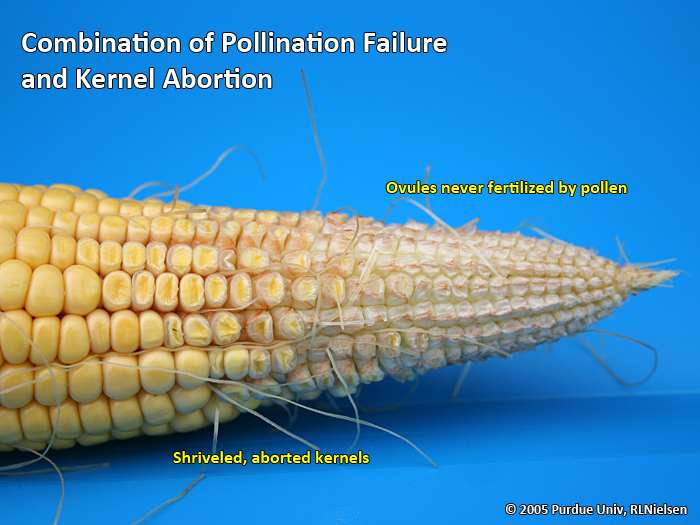
One of the causes of incomplete kernel set is unsuccessful fertilization of the ovules during pollination. Unsuccessful fertilization results in ovules that never develop into kernels and, subsequently, ears with varying degrees and patterns of incomplete kernel set. Many factors can cause incomplete pollination and distinguishing between them can be very difficult.
- Certain insects like corn rootworm beetles and Japanese beetles can interfere with pollination and fertilization by their silk clipping activities. These insects inadvertently clip silks as they feed on pollen captured by the silks. Unusually early or late pollinating fields are often particularly attractive to these insects.
- Drought stress may delay silk emergence until pollen shed is nearly or completely finished. During periods of high temperatures, low relative humidities, and inadequate soil moisture levels, exposed silks may also desiccate rapidly and become non-receptive to pollen germination.
- Conversely, silk emergence of some drought tolerant hybrids may occur several days prior to the availability of pollen from the tassels when soil moisture levels are favorable for crop growth. Although silks remain receptive to pollen germination for up to 10 days after emergence, they begin to slowly deteriorate (age, desiccation) after 4 to 5 days. Because the first silks to emerge are from ovules near the base of the cob, kernel set near the base of the cob may fail under these conditions. See my related article for more information.
- Unusually favorable conditions prior to pollination that favor ear size determination can result in ears with an unusually high number of potential kernels per row. Remember that silk elongation begins near the butt of the ear and progresses up toward the tip. The tip silks are typically the last to emerge from the husk leaves. If ears are unusually long (many kernels per row), the final silks from the tip of the ear may emerge after all the pollen has been shed.
Another cause of incomplete kernel set is abortion of fertilized ovules. Aborted kernels will be shrunken, mostly white, often with the yellow embryo visible; compared to normal plump yellow kernels. Unfertilized ovules, on the other hand, will result in visibly blank areas on the cob.
Kernels are most susceptible to abortion during the first 2 weeks following pollination, particularly kernels near the tip of the ear. Tip kernels are generally last to be fertilized, less vigorous than the rest, and are most susceptible to abortion. Once kernels have reached the dough (R3) stage of development, further yield losses will occur mainly from reductions in kernel dry weight accumulation.
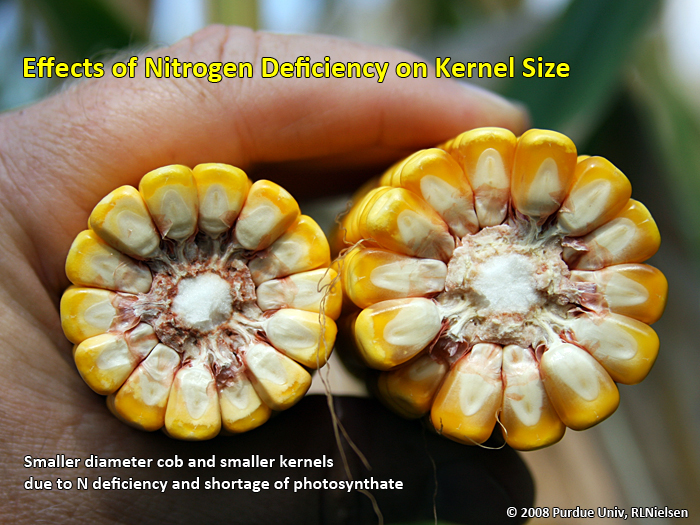
Kernel abortion can be caused by any stress that greatly limits photosynthetic rates and, thus, photosynthate availability during or shortly following pollination...
- Severe drought stress.
- Excessive heat stress.
- Severe nutrient deficiencies (especially nitrogen).
- Extensive loss of green leaf tissue by foliar diseases like gray leaf spot (Cercospora zeae-maydis).
- Extensive loss of green leaf tissue from severe hail damage.
- Consecutive days of heavily overcast, cloudy conditions.
Decreased Kernel Weight
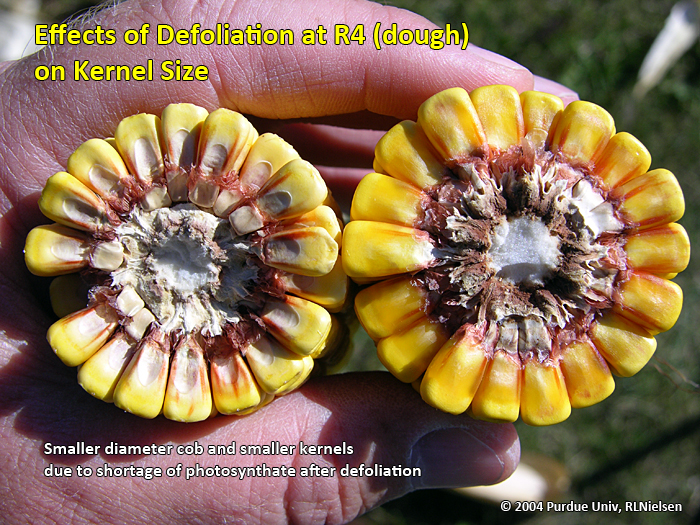
Severe photosynthetic stress during dough (R4) and dent (R5) stages of grain fill reduces kernel weight and can cause premature kernel black layer formation. Decreased kernel weight can result from severe drought and heat stress during grain fill; extensive European corn borer tunneling (especially in the ear shanks); loss of photosynthetic leaf area by nutrient deficiency, hail, insects, or disease during grain fill; and killing fall frosts prior to normal black layer development.
Once grain has reached physiological maturity (R6), severe stress will have no further physiological effect on final grain yield per se. However, severe stress prior to R6 can weaken stalk tissue and predispose the plants to the development of stalk rots (see my related article). Weakened or rotted stalks combined with post-maturity damaging wind storms can easily result in significant mechanical harvest losses and, thus, less grain in the bin.
Premature Plant Death
A killing fall frost prior to physiological maturity can cause premature leaf death or whole plant death. Premature death of leaves results in yield losses because the photosynthetic "factory" output is greatly reduced. The plant may remobilize stored carbohydrates from the leaves or stalk tissue to the developing ears, but yield potential will still be lost. Approximate yield losses due to premature death of leaves, but not stalks, range from 36, 31, and 7% when the leaf death occurs at R4 (dough), R5 (full dent), and half-milkline stages of kernel development, respectively (Afuakwa & Crookston, 1984).
Premature death of whole plants results in greater yield losses than if only leaves are killed. Death of all plant tissue prevents any further remobilization of stored carbohydrates to the developing ear. Whole plant death that occurs before normal black layer formation will cause premature black layer development, resulting in incomplete grain fill and lightweight, chaffy grain. Grain moisture will be greater than 35%, requiring substantial field drydown before harvest. Approximate yield losses due to premature whole plant death range from 50, 39, and 12% when the whole plant death occurs at R4 (dough), R5 (full dent), and half-milkline stages of kernel development, respectively (Afuakwa & Crookston, 1984).
A common misconception is that kernel black layer formation sometimes fails to occur following a frost or other late-season severe stress. Not true. FAKE NEWS! The kernel black layer always develops. Any severe stress that occurs during the grain fill period will cause premature kernel black layer formation and is related to the reduction in or termination of sucrose (photosynthate) availability to the developing kernels (Afuakwa et al., 1984).
Related References
Afuakwa, J. J. and R. K Crookston. 1984. Using the kernel milk line to visually monitor grain maturity in maize. Crop Sci. 24:687-691.
Afuakwa, J.J., R.K. Crookston, and R.J. Jones. 1984. Effect of Temperature and Sucrose Availability on Kernel Black Layer Formation in Maize. Crop Sci. 24:285-288.
Nielsen, R.L. (Bob). 2007. Ear Size Determination in Corn. Corny News Network, Purdue Univ. http://www.kingcorn.org/news/timeless/EarSize.html. [URL accessed Jul 2018].
Nielsen, R.L. (Bob). 2016. Silk Emergence. Corny News Network, Purdue Univ. http://www.kingcorn.org/news/timeless/silks.html. [URL accessed Jul 2018].
Nielsen, R.L. (Bob). 2016. Tassel Emergence & Pollen Shed. Corny News Network, Purdue Univ. http://www.kingcorn.org/news/timeless/Tassels.html. [URL accessed Jul 2018].
Nielsen, R.L. (Bob). 2017. Grain Fill Stages in Corn. Corny News Network, Purdue Univ. http://www.kingcorn.org/news/timeless/GrainFill.html. [URL accessed Jul 2018].
Nielsen, R.L. (Bob). 2017. Stress During Grain Fill: A Harbinger of Stalk Health Problems. Corny News Network, Purdue Extension. http://www.kingcorn.org/news/timeless/StalkHealth.html [URL accessed Jul 2018].
Nielsen, R.L. (Bob). 2018. Kernel Set Scuttlebutt. Corny News Network, Purdue Univ. [online] http://www.kingcorn.org/news/timeless/KernelSet.html. [URL accessed Jul 2018].
Nielsen, R.L. (Bob). 2018. Unusually Long Silks in Corn. Corny News Network, Purdue Univ. http://www.kingcorn.org/news/timeless/LongSilks.html [URL accessed Jul 2018]