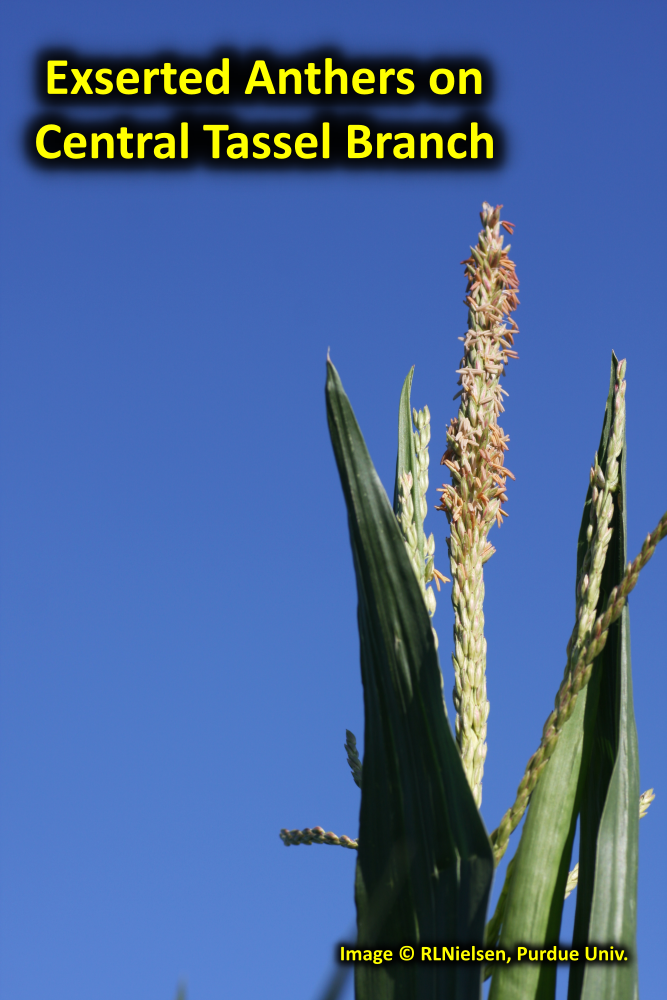
Exserted anthers on central tassel branch.
As important as this process is to the determination of grain yield, it is surprising how little some folks know about the whole thing. Rather than leaving you to learn about such things "on the streets", I've developed this article and the accompanying one on silking (Nielsen, 2020) that describe the ins and outs of sex in the corn field.
Remember that corn has both male flowers and female flowers on the same plant (a flowering habit called monoecious for you trivia fans.) Interestingly, both flowers are initially bisexual (aka "perfect" flowers), but early in their development the female components (gynoecia) of the male flowers and the male components (stamens) of the female flowers abort, resulting in tassel (male) and ear (female) floral development.
Portions of the tassel may be visible before the plant technically reaches its final leaf stage (uppermost, final visible leaf collar) has occurred. By definition, growth stage VT occurs when the last branch of the tassel emerges from the whorl (Abendroth et al., 2011). This source furthermore states that growth stage VT is "...initiated when the last branch of the tassel is completely visible and the silks have not yet emerged." Once upon a time, that exact developmental sequence may have been true, but today's hybrids tend to behave differently. It is not uncommon for silk emergence (growth stage R1) to begin not only prior to the last tassel branch appearing from the whorl, but sometimes prior to the exsertion of anthers and the beginning of pollen shed (Nielsen, 2018).
Maximum plant height occurs at or shortly after growth stage VT as the final stalk internodes complete their elongation. The corn plant is most vulnerable to hail damage at growth stage VT/R1 because all of its leaves are exposed. Complete (100 %) leaf loss at growth stage VT will usually result in complete (100 %) yield loss by harvest. Even if the ovules on the ears are successfully fertilized by the pollen, severe defoliation at growth stage VT/R1 often causes entire ear shoots to die because so few leaves remain to produce the necessary carbohydrates (by photosynthesis) to sustain ear and kernel development.
Approximately 1,000 individual spikelets form on each tassel and each one bears two florets encased in two large glumes. Each floret contains three anthers. An anther and its attached filament comprise the stamen of the male flower. The anthers are those "thingamajigs" that hang from the tassel during pollination. Under a magnifying lens, individual anthers look somewhat like the double barrel of a shotgun. Do the math and you will realize that an individual tassel produces approximately 6,000 pollen-bearing anthers, although hybrids can vary greatly for this number.
As the florets mature, elongation of the filaments allows the anthers to emerge ("exsert" for you trivia fans) from the glumes. Pollen is dispersed through pores at the tips of the anthers that open as the anthers exsert from the glumes. Anther exsertion and pollen shed usually begin in the mid-portion of the central tassel spike and then progresses upward, downward and outward over time. Anthers typically emerge from the upper floret of a pair first, while those from lower floret typically emerge later the same day or on following days. After its pollen is shed, "spent" anthers eventually drop from the tassel and are sometimes mistaken for the pollen when observed on the leaves or ground.
The yellow or white “dust-like” pollen that falls from a tassel represents millions of individual, nearly microscopic, spherical, yellowish- or whitish translucent pollen grains. Estimates of the total number of pollen grains produced per tassel range from 2 to 25 million (yes, they are difficult to count). Each pollen grain contains the male genetic material necessary for fertilizing the ovary of one potential kernel.
The outer membrane of a pollen grain is very thin. Once dispersed into the atmosphere, pollen grains remain viable for only a few minutes before they desiccate. Yet, with only a 15 mph wind, pollen grains can travel as far as 1/2 mile within those couple of minutes.
Therein lies the concern of the potential for pollen “drift” from a transgenic corn field to an adjacent non-transgenic corn field and the risk of transgenic “contamination” of grain intended for non-transgenic markets. The good news is that research suggests that the overwhelming majority of a corn field’s pollen load is shed in the field itself.
All of the pollen from a single anther may be released in as little as three minutes. All the anthers on an individual tassel may take as long as seven days to finish shedding pollen, although the greatest volume of pollen is typically shed during the second and third day of anther emergence. Because of natural field variability in plant development, a whole field may take as long as 14 days to complete pollen shed.
Peak pollen shed usually occurs in mid-morning. Some research indicates that pollen shed decreases after temperatures surpass 86F. A second “flush” of pollen often occurs in late afternoon or evening as temperatures cool. Pollen shed may occur throughout most of the day under relatively cool, cloudy conditions.
Weather conditions influence pollen shed. If the anthers are wet, the pores will not open and pollen will not be released. Thus, on an average Indiana summer morning following a heavy evening dew, pollen shed will not begin until the dew dries and the anther pores open. Similarly, pollen is not shed during rainy conditions. Cool, humid temperatures delay pollen shed, while hot, dry conditions hasten pollen shed.
Extreme heat stress (100F or greater) can kill corn pollen, but fortunately the plant avoids significant pollen loss by virtue of two developmental characteristics. First of all, anthers do not mature at the same time up and down the tassel, nor does complete pollen shed occur on a single day. Anther maturation and pollen shed occur over several days and up to two weeks. Therefore, a day or two of extreme heat usually does not affect the entire pollen supply. More importantly, the majority of daily pollen shed occurs in the morning hours when air temperature is much more moderate.
Abendroth, L.J., R.W Elmore, M.J. Boyer, and S.K. Marlay. 2011. Corn Growth and Development. Iowa State Univ. Extension Publication #PMR-1009. https://store.extension.iastate.edu/Product/Corn-Growth-and-Development [URL accessed July 2020].
Nielsen, RL (Bob). 2016. A Fast & Accurate Pregnancy Test for Corn. Corny News Network, Purdue Univ. [On-Line]. Available at http://www.kingcorn.org/news/timeless/EarShake.html [URL accessed July 2020].
Nielsen, RL (Bob). 2018. Unusually long silks in corn. Corny News Network, Purdue Univ. [online] http://www.kingcorn.org/news/timeless/LongSilks.html [URL accessed July 2020].
Nielsen, RL (Bob). 2020. Silk Emergence. Corny News Network Purdue Univ. [On-Line]. Available at http://www.kingcorn.org/news/timeless/Silks.html [URL accessed July 2020].
Russell, W.A. and A.R. Hallauer. 1980. Corn. (a chapter in Hybridization of Crop Plants. American Soc. of Agronomy-Crop Science Soc. of America. Madison, WI.
Click image to view larger version in a popup window. Left or right arrow on your keypad will cycle through the popup images.
Exserted anthers on central tassel branch.
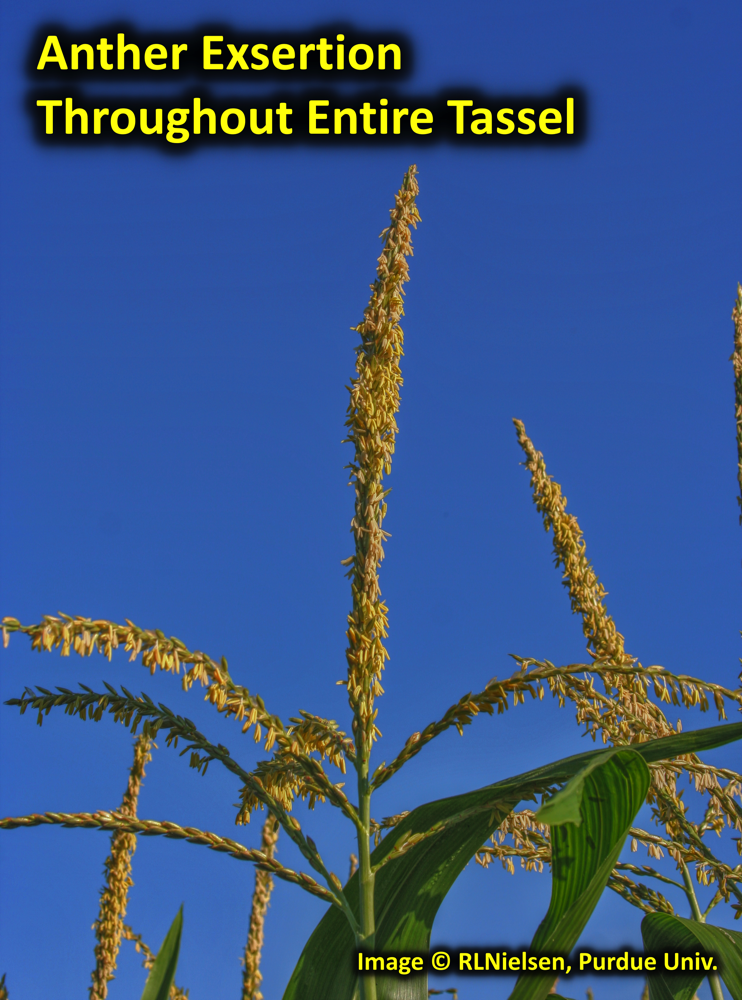
Exserted anthers throughout entire tassel.
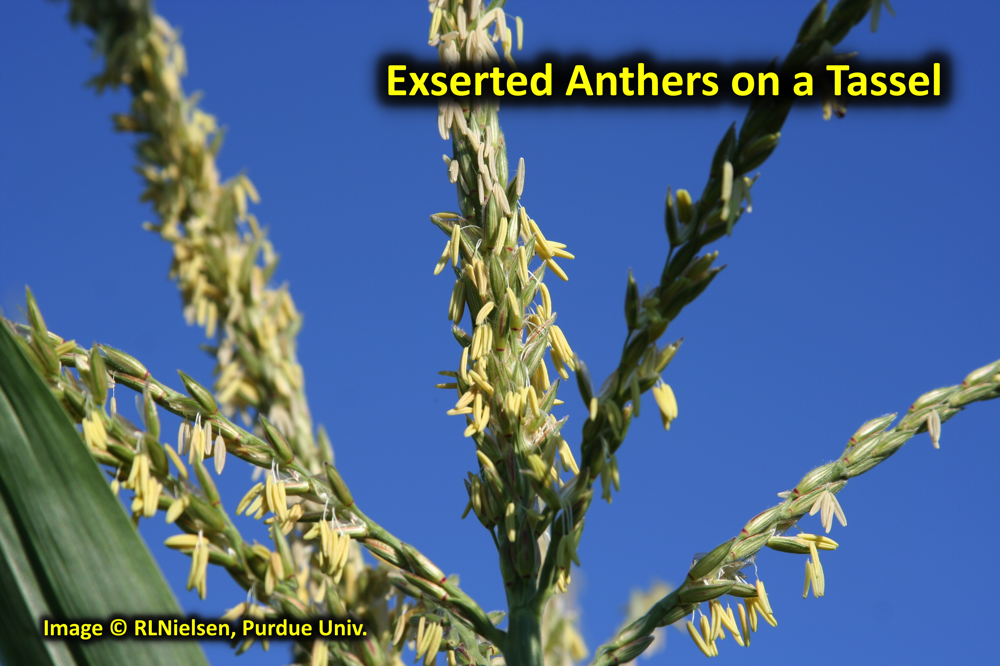
Exserted anthers on a tassel.
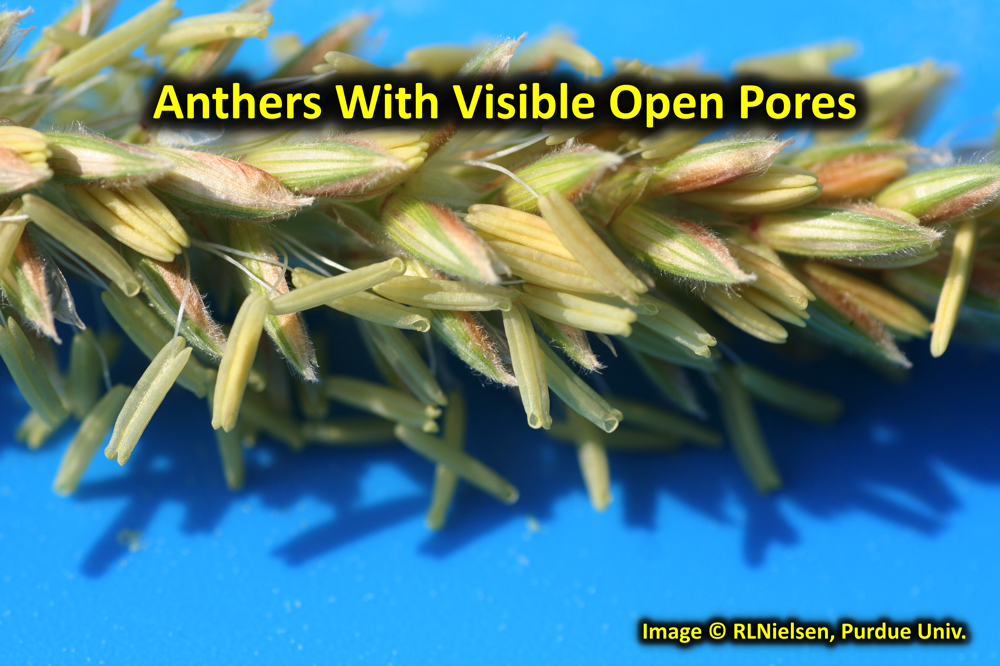
Closeup of anthers.
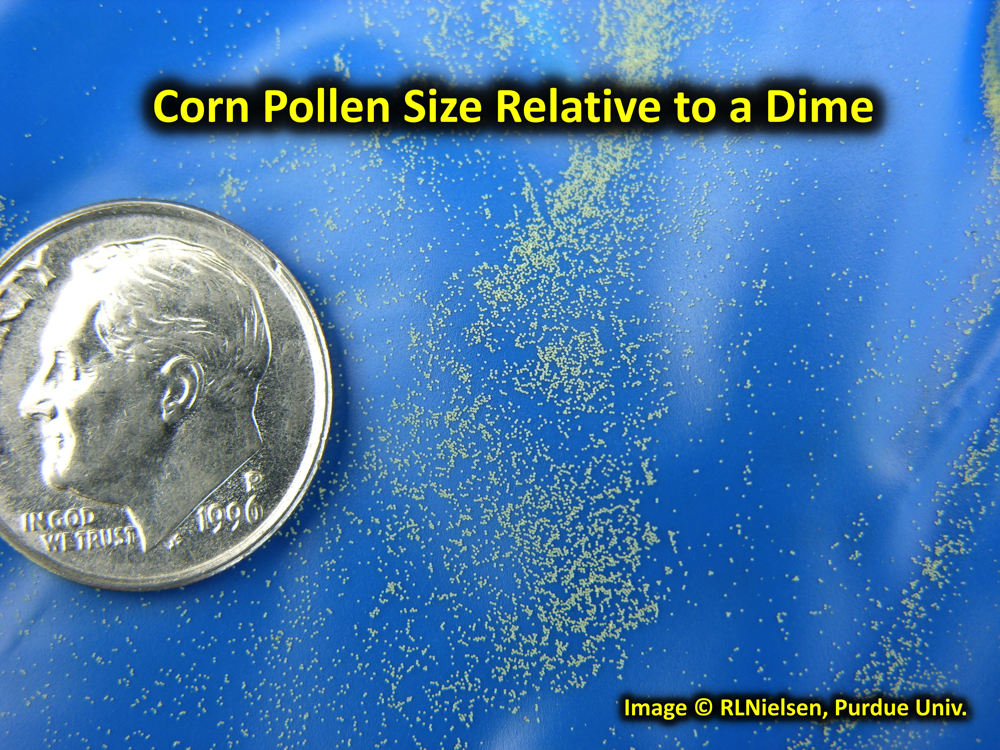
Corn pollen size relative to a dime.