Updated June 2022
URL: http://www.kingcorn/news/timeless/FloppyCorn.html
"Rootless" or "Floppy" Corn Syndrome
R.L. (Bob) Nielsen
Agronomy Dept., Purdue Univ.
West Lafayette, IN 47907-2054
Email address: rnielsen at purdue.edu
Twitter: @PurdueCornGuy
Factors that contribute to a high risk for "rootless" or "floppy" corn syndrome in 2022 include...
- Late May or later planting,
- Shallow planting,
- Dry surface soils, and
- Multiple, consecutive days of extreme heat (upper 90s)
 xcessive drying of the upper soil profile is conducive for the development of what some of us affectionately call the "rootless corn" or "floppy corn" syndrome. The problem illustrates a classic example of the importance of the timing of stress relative to stage of plant development.
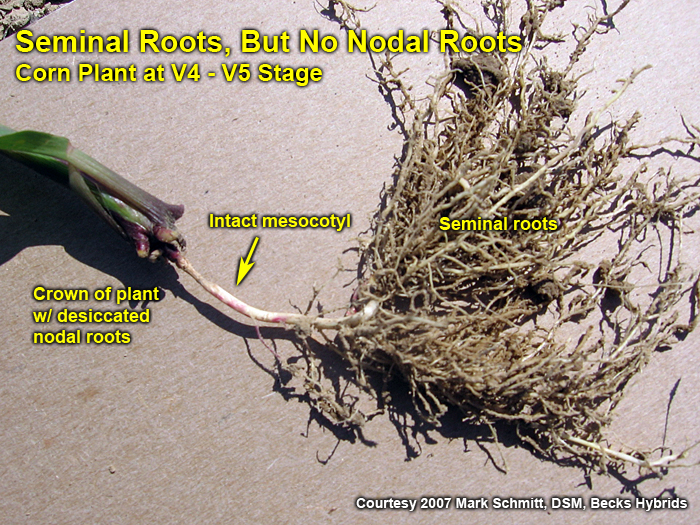
Seminal roots, but no upper nodal roots. (Click on image to open a larger version.)
The permanent (aka nodal) roots of a corn plant initially elongate from nodes near the crown area of the young plant (approximately 3/4 inch below the soil surface) and first become visible between leaf collar stages V1 and V2 (Nielsen, 2020). The young roots develop in individual sets or "whorls", beginning with the lowermost node of the stalk and progressing sequentially over time in an acropetal fashion up to Node #6 or so. The main growing point or meristem of a root is located just behind the tip of the root and must remain alive in order for the root to develop normally.
Roots elongate downward primarily in response to gravity (i.e., a positive gravitropic response). There is evidence that roots also respond to soil moisture gradients (hydrotropism) by elongating toward soil regions with more favorable moisture levels (Eagen et al., 2005; Rodríguez and Cassab, 2021). However, the overarching determinant of roots' downward growth is likely gravity.
If nodal roots begin their initial elongation in bone-dry surface soil but elongate downward to adequate soil moisture at deeper depths before the meristematic root tip desiccates, then the root will survive and proliferate. If the root tip (and its accompanying meristem) desiccates prior to reaching soil moisture, the entire young nodal root often dies. This is particularly true if the axillary meristems along the length of the root (that eventually produce the adventitious branch roots) have not yet differentiated or become active.
The desiccating effect of bone-dry surface soils on young, newly elongating nodal roots is exacerbated by sunny weather and hot temperatures. Dry soil warms more quickly, and dramatically, than wet soil. On a warm, sunny day with air temperatures in the high 80s to low 90s F, soil temperature at the 3/4 inch or depth can exceed lethal levels for young roots. This is especially true for residue-free, conventionally-tilled fields.
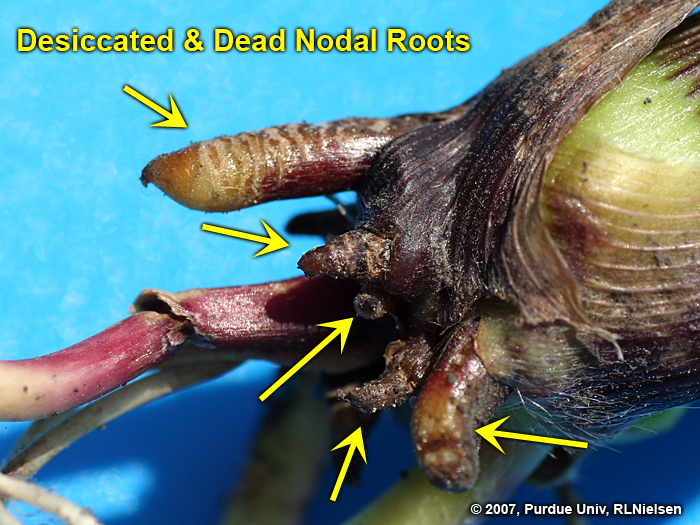
Desiccated & dead nodal roots.
The appearance of desiccated roots is what one would imagine; they are shriveled and discolored. This symptom is unlike that of any other lethal root stress, including salt injury from fertilizer. These symptoms are NOT like any associated with herbicide injury or insect feeding.
An entire set or "whorl" of nodal roots can emerge and die within the course of a few days. If this happens to the first set of roots (Node #1) as they begin to elongate (between leaf stages V1 and V2), the young plant survives on what's left in the kernel reserves and what the seminal roots offer in terms of moisture and nutrient uptake until the next set of nodal roots develop and become established. If subsequent sets of nodal roots die in the same manner, the plant continues its dependence on the kernel and seminal root support.
In fact, it is amazing to me how the aboveground appearance of a plant whose nodal roots are desiccating and dying can appear fairly normal up until the fateful windy day when the mesocotyl simply can no longer support the plant and it literally flops over to the ground. "Floppy" corn plants are NOT technically root-lodged; they are simply broken over at the mesocotyl below the crown area of the plant. Obviously, the health of the mesocotyl and the seminal roots determine whether an affected plant can "hang on" until a decent "soaker" of a rain occurs to replenish soil moisture levels.
I began this article by telling you that the "Floppy Corn" Syndrome is a classic example of the importance of the timing of stress versus stage of plant development. Rooting of young plants is most vulnerable to the effects of dry surface soils up until the nodal root system has been fairly well-established (about V5 or V6). Consequently, "Floppy Corn" is more likely to occur in a field of younger, recently-planted corn than an adjacent field of older, earlier-planted corn whose nodal root development is farther along.
CORNY TRIVIA: Sometimes when several sets of nodal roots desiccate and die, the crown of the young plant may "appear" to be at or above the soil surface. That appearance is an optical illusion except in a few cases (Nielsen, 2004).
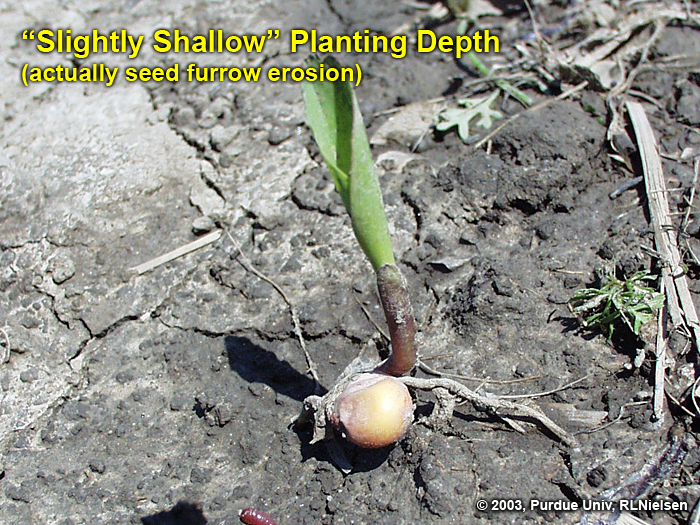
"Slightly shallow" seeding depth.
What Can Be Done to Alleviate the Problem? Unfortunately, very little can be done to prevent the situation from becoming worse. Row cultivation may encourage new nodal root development if moist soil is thrown around the base of the plants. However, if the soil is dry enough to be causing the problem in the first place, there's probably very little moist soil shallow enough to be brought up by row cultivation. The ultimate solution to the problem is a good soaking rain or at least enough of a rain to sustain new nodal root development long enough to allow the roots to reach deeper and hopefully wetter soil conditions before the upper soil dries again.
'Hindsight" Reminders or Foresight Advice.
- "Rootless" corn develops more easily with extremely shallow seeding depths that results in nodal root initiation beginning closer to the soil surface than at the usual approximate 3/4 inch depth. This is one of several reasons that growers should avoid choosing seeding depths shallower than about 1 to 1-1/2 inches.
- Conversely, unusually deep planting (more than 2 inches) does not result in unusually deeper initial root elongation because the light-mediated elongation of the mesocotyl during emergence results in the crown of the seedlings being at roughly the same depth (3/4 inch) below the soil surface.
- Furrow erosion after planting, as a result of heavy rains, can create "shallow planted" seed as a consequence of removing topsoil.
- Shallow soil compaction from shallow tillage of fields that are "just a little on the wet side" can restrict initial nodal root development to the shallow, and often dry, soil above the compacted layer.
- Open seed slots resulting from no-till planting "on the wet side" can contribute to the desiccation and death of initial nodal root development if the initial nodal roots desiccate before they successfully penetrate through the furrow sidewalls.
Cited and Related References
Eapen, Delfeena, María L. Barroso, Georgina Ponce, María E. Campos, and Gladys I. Cassab. 2005. Hydrotropism: root growth responses to water. Trends in Plant Science 10 (1):44-50. https://doi.org/10.1016/j.tplants.2004.11.004 [accessed June 2022].
Elmore, Roger and Lori Abendroth. 2007. Rootless Corn Syndrome. Integrated Crop Management Newsletter, Iowa State Univ. https://crops.extension.iastate.edu/encyclopedia/rootless-corn-syndrome-0. [accessed June 2022].
Hoegemeyer, Tom. 2012. Why "Rootless" Corn is so Prevalent in Drier Areas this Year. CropWatch, Univ Nebraska Extension. http://cropwatch.unl.edu/why-rootless-corn-so-prevalent-drier-areas-year-unl-cropwatch-june-2012. [accessed June 2022].
Lauer, Joe. 2001. Rootless or "Floppy" Corn. Wisconsin Crop Manager Newsletter, Univ. of Wisconsin. http://corn.agronomy.wisc.edu/WCM/W090.aspx. [accessed June 2022].
Nielsen, R.L. (Bob). 2004. Over-Extended Mesocotyls and Floppy Corn Syndrome. Corny News Network, Purdue Extension. http://www.kingcorn.org/news/articles.04/FloppyCorn-0624.html. [accessed June 2022].
Nielsen, R.L. (Bob). 2007. Variable Emergence Due to Variable Seedbed Moisture. Corny News Network, Purdue Extension. http://www.kingcorn.org/news/articles.07/VariableEmergence-0520.html. [accessed June 2022].
Nielsen, R.L. (Bob). 2020. Root Development in Young Corn. Corny News Network, Purdue Extension. http://www.kingcorn.org/news/timeless/Roots.html. [accessed June 2022].
Rodríguez, Mery Nair Sáenz and Gladys Iliana Cassab. 2021. Primary Root and Mesocotyl Elongation in Maize Seedlings: Two Organs with Antagonistic Growth below the Soil Surface. Plants 10:1274. https://doi.org/10.3390/plants10071274 [accessed June 2022].
Thomison, Peter. 2016. Rootless and Floppy Corn. C.O.R.N., Ohio State Extension. https://agcrops.osu.edu/newsletter/corn-newsletter/rootless-and-floppy-corn. [accessed June 2022].
Wiebold, William. 2012. Rootless Corn. Integrated Pest & Crop Management, Univ. Missouri Extension. https://ipm.missouri.edu/ipcm/2012/5/Rootless-Corn. [accessed June 2022].
More Images...
Click on an image to open a larger version.
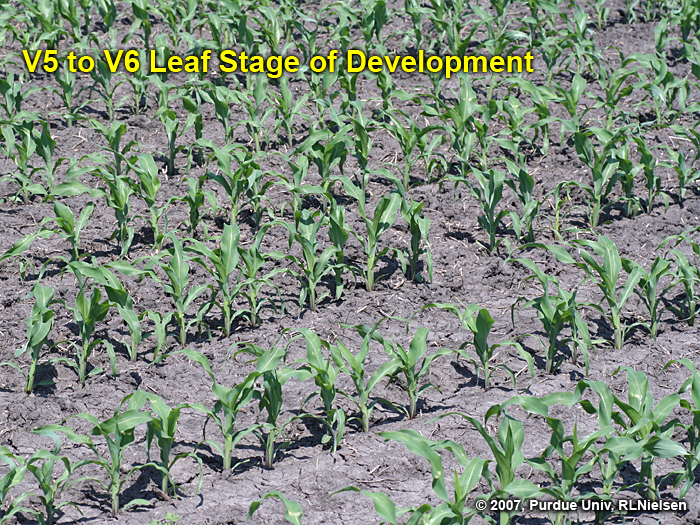
Corn at V5 to V6.
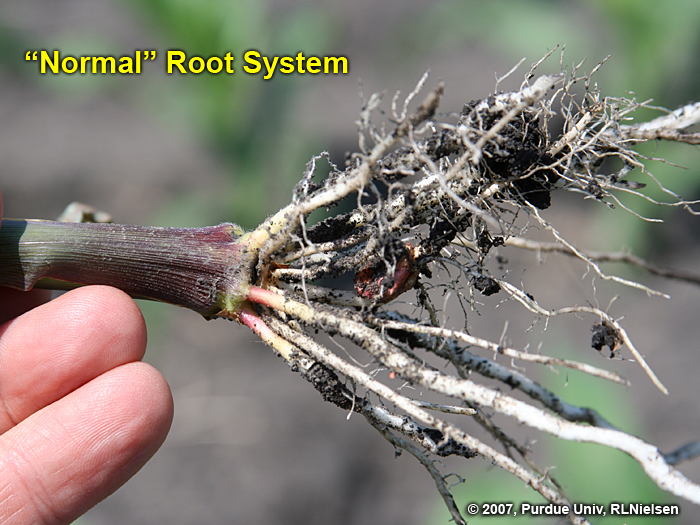
Root system of "normal" plant.
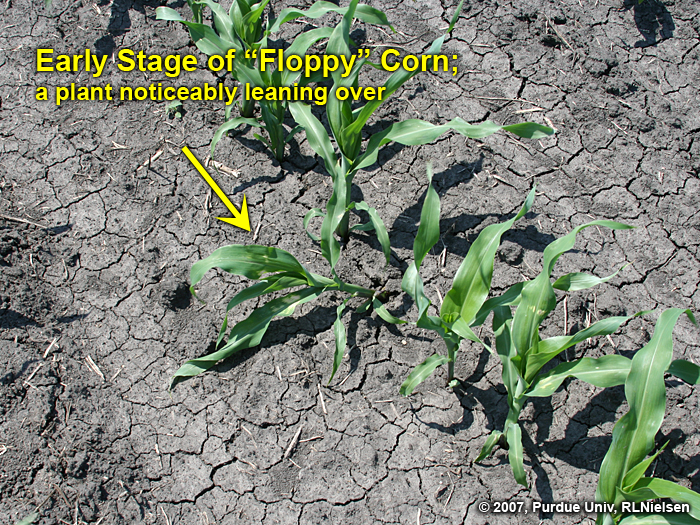
Early stage of "floppy" corn.
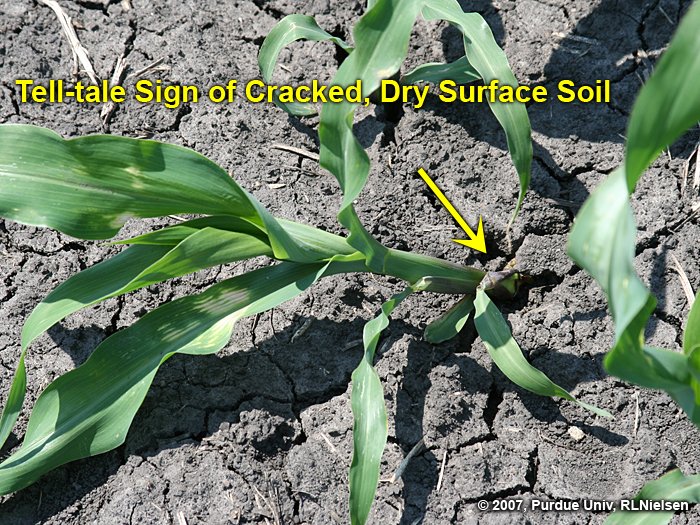
Early stage of "floppy" corn.
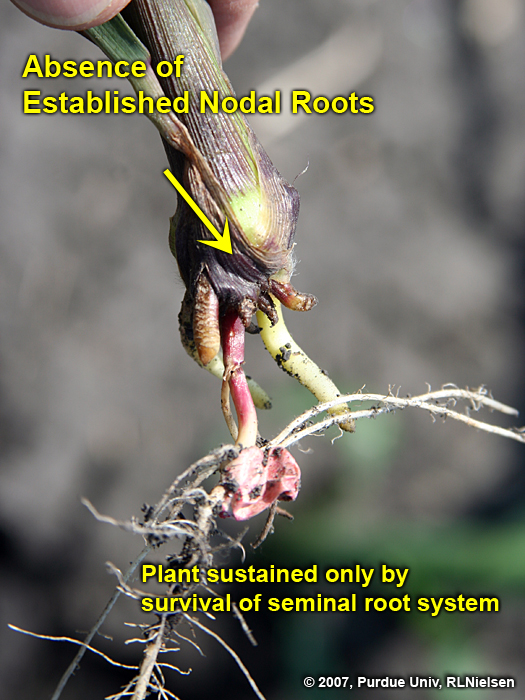
Absence of established nodal roots.
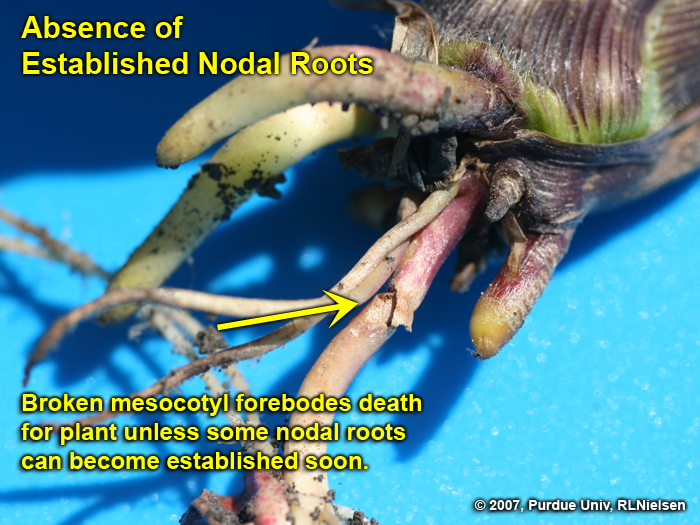
Broken mesocotyl.