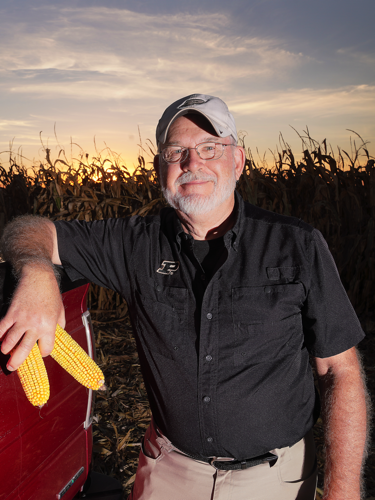
R.L. (Bob) Nielsen
Professor Emeritus of Agronomy
Purdue University, West Lafayette, Indiana, USA
765.427.2478 (mobile)
Research Interests
Corn response to plant populations
Corn response to nitrogen fertilizer rates
Enhancing crop management decisions using UAV imagery
Corn response to sulfur fertilizer
Corn response to starter fertilizer
Corn response to biological in-furrow soil amendments
Awards and Recognition
2023 - Professor Emeritus of Agronomy - Purdue University
2020 - Honorary Master Farmer - Indiana Prairie Farmer Magazine and Purdue College of Agriculture
2019 - Outstanding Service to American & World Agriculture Award - National Assoc. of County Ag. Agents
2018 - Distinguished Service Award - Indiana Crop Improvement Assoc.
2016 - Frederick L. Hovde Award of Excellence - Indiana Farm Bureau
2015 - Beyond the Fence Ag Education Outreach Award - Beck's Hybrids / Indiana Corn Marketing Council / Indiana Soybean Alliance
2010 - Certificate of Distinction - Purdue Ag. Alumni Assoc.
2009 - Agronomic Extension Education Award - American Soc. Agronomy
2002 - Crops & Soils Award - Indiana Crop Improvement Assoc.
1999 - Eric G. Sharvelle Distinguished Extension Specialist Award - Purdue University Extension
1995 - Werner L. Nelson Award for Diagnosis of Yield-Limiting Factors - American Soc. Agronomy
1989 - USDA Unit Award for Superior Service
My Responsibilities at Purdue University
Sep 1982 - Current
I was raised on a farm in eastern Nebraska, obtained a B.S. degree at the Univ. of Nebraska and graduate degrees at the Univ. of Minnesota. I joined the Agronomy faculty at Purdue in 1982 with statewide responsibilities for applied field research, graduate student training, and Extension programming with an emphasis on corn management practices. After 40 years of having the privilege to serve Indiana agriculture as Purdue's "Corn Guy", I retired from Purdue on 31 December 2022.
My Extension programming focused on optimizing yield, profitability, and stewardship of corn production for growers in Indiana and throughout the eastern Corn Belt. Over those 40 years, I shared my experience and knowledge of corn with more than 720,000 farmers and their advisors at over 2,000 Extension programs in Indiana and elsewhere in the U.S. I also had the opportunity to travel internationally, with invited participation in farmer conferences in Canada, Hungary, Argentina, New Zealand, Russia, Italy, South Africa and Mexico. The last 15+ years of my field scale research focused on identifying the optimal management of nitrogen fertilizer, seeding rates, starter fertilizer, sulfur fertilizer, biological in-furrow amendments, and the use of small UAVs for crop scouting and field research.
Since the mid-1990's, I made extensive use of the Web as an Extension communication medium. My primary online presence was the KingCorn Web site that included the popular Chat 'n Chew Cafe page that provided a "1-stop shop" for links to timely agronomic newsletters from landgrant universities throughout the Midwest, plus links to educational events and useful crop management references. In its heday, the "KingCorn" Web site was attracting between 300,000 and 400,000 views each year. Those Web sites have since been decommissioned in deference to "The Kernel" developed by my successor, Dr. Dan Quinn in 2021. For the immediate future, you can still access many of my Corny News articles at my "Corny News Compendium" Web page or indirectly from Dan's Web site.
Extension Programs in Corn Management
- Corn Growth and Development
- Effects of Stress on Corn
- Stand Establishment Issues in Corn
- Corn Replant Decision-making
- High Yield Corn: Philosophies & Strategies
- Crop Problem Troubleshooting
- Crop Resilience to "Normal" Weather
- Yield Monitors and Yield Data: Best Management Practices
- Technology Transfer and Distance Education via the World Wide Web
- Continuous Corn: Best Management Practices
- On-farm Research: Why and How?
- Precision Ag. Technologies and Crop Management
- Uses for UAV Imagery in Crop Management
- Fact vs. Fiction: Filter the Kool-Aid Before You Drink It
- Managing Nitrogen Fertilizer for Corn
- Corn Response to Sulfur in Indiana
- Strategies for Improving Profitability in Corn Production
- Transgenic Crop Issues
Extension publications
After the Internet and the World Wide Web became widely available to the general public in the mid-1990's, I focused much of my Extension communications in the form of online newsletter articles under the banner of the "Corny News Network (CNN)". Most of those are available in my Corny News Compendium.
In March 2020, Shaun Casteel (Ext. Soybean Specialist) and I initiated the Purdue Crop Chat podcast series, in collaboration with Hoosier Ag Today. In the summer of 2021, my successor Dan Quinn took my place on the Podcast.
YouTube videos of several of my presentations are available for your perusal at my YouTube channel at https://www.youtube.com/@purduecornguy.
More formal Extension publications I authored or co-authored are listed below.
- Corn and Soybean Field Guide (ID-179)
- Corn and Soybean Field Guide App for iPad (ID-179-APP)
- Corn Field Scout app for Apple iOS and Android (ID-179C-APP)
- Purdue Crop Cost & Return Guide (ID-166-W)
- The Making of Effective Extension Presentations (PPP-81)
- The online version is a very large PDF file (22MB).
- Arrested Ear Development in Corn (BP-85-W)
- Diseases of Corn: Stalk Rots (BP-89-W)
- Estimating Yield and Dollar Returns From Corn Replanting (AY-264-W)
- Delayed Planting & Hybrid Maturity Decisions (AY-312-W)
- Corn Growth & Development: What Goes On From Planting to Harvest? (AGRY-97-07)
- USDA Grading Standards and Moisture Conversion Table for Corn (AY-225)
- The Indiana 4-H Corn Project -- Corn: The Plant, Problems, and Products (4-H 672)
- The Indiana 4-H Corn Project -- Hybrid Corn: Selecting, Growing, Harvesting, Using (4-H 763)
- The Indiana 4-H Corn Project -- Corn Growth: Nutrients, Tillage, Hybrids, and Production (4-H 674)