July 2022
URL: http://www.kingcorn.org/news/timeless/EarShake.html
A Fast & Accurate Pregnancy Test for Corn
R.L. (Bob) Nielsen
Agronomy Dept., Purdue Univ.
West Lafayette, IN 47907-2054
Email address: rnielsen at purdue.edu
Twitter: @PurdueCornGuy
- Pollination may fail for a number of reasons, including drought stress and insect damage to silks.
- Silks normally detach from fertilized ovules within days of successful pollination.
- The ear shake test takes advantage of this "symptom" and can be used as an early indicator of pollination progress and/or success.
Pollination in corn is the act of transferring pollen from the tassels to the emerged silks of the ear. Germination of pollen grains on receptive silks results in a pollen tube, containing the male genetic material, that penetrates and grows within the silk tissue down to the connected female ovule attached to the cob. Successful fertilization of the ovule by the pollen results in a kernel of corn.
Unfortunately, pollination of the silks and/or fertilization of the ovules sometimes fails. Severe drought and/or heat stress can interfere with the synchrony between pollen availability and silk emergence or can desiccate exposed silks rendering them non-receptive to captured pollen grains. Silk clipping by corn rootworm beetles, Japanese beetles, and other obnoxious critters during pollination can be severe enough to impede pollen capture and germination.
Growers usually want an early assessment of the success of pollination, especially when a decision needs to be made whether insecticide applications are warranted to prevent further silk clipping by insects. Obviously, one could wait impatiently until kernel development was visibly apparent. Within about 10 to 14 days after pollen shed, developing kernels will resemble white blisters on the cob (Nielsen, 2021). Luckily for us, the corn plant exhibits an earlier indicator of pollination progress.
Silk Detachment From Fertilized Ovules
Remember that each ovule (potential kernel) on the ear develops a silk (the functional “style” of the female flower) that elongates and eventually emerges through the ear’s husk leaves the tip of the ear shoot (Nielsen, 2020a). The silks represent the "pathway" for the male gametes in the pollen to fertilize the female gametes in the ovules.
Once a pollen grain is "captured" by a trichome or "hair" of a silk, the pollen grain germinates and develops a pollen tube that contains the male genetic material. The pollen tube penetrates the silk and, with adequate moisture and temperature, elongates down the length of the silk within 24 hours and fertilizes the ovule.
Within 2 to 3 days after an ovule has been successfully fertilized, the base of the attached silk will collapse and detach from the immature kernel. The kernel itself will usually not be recognizable to the naked eye at this stage. Silks of nonfertilized ovules remain attached, however, and will continue to lengthen and be receptive to pollen for up to 10 days after emergence from the ear shoot. Even if never fertilized, silks will remain attached to the ovules. Within days of full silk emergence, therefore, pollination progress may be estimated on individual ears by estimating percent silk detachment.
The Ear Shake Technique
For each ear, make a single lengthwise cut from the base of the ear shoot to the tip with a sharp knife, through the husk leaves to the cob. Slowly unwrap the husk leaves, taking care not to physically rip any silks from the ovules yourself. Then gently shake the ear. Silks of fertilized ovules will drop away; silks from unfertilized ovules will remain attached.
With practice, pollination progress can be easily determined by estimating the percentage of silks that fall away from the cob. Sampling ears at random throughout a field will provide an indication of the progress of pollination for the whole field.
 Watch video of the ear shake technique.
One Last Comment
While the "ear shake" technique helps you estimate pollination progress with respect to ovule fertilization, remember that pollination progress includes pollen shed progress. Check the tassels in early to mid-morning hours to determine whether anther exsertion and pollen shed are still occurring.
Remember, that anther exsertion and pollen shed typically begin on the central tassel stalk, then spreads progressively throughout the tassel branches (Nielsen, 2020b). If no further pollen shed is likely to occur, it doesn't matter how badly those nasty insects are clipping silks. Unfertilized ovules will remain unfertilized ovules if there is no pollen left in the field. Spraying the bejeebers out of a field at that point is simply a costly form of revenge.
Related References
Nielsen, RL (Bob) and John Obermeyer. 2012. Ear Shake Test to Determine Corn Pollination Progress. Purdue Extension PurdueExtensionEntm YouTube Channel. https://youtu.be/K7DiwD4N0T0 [URL accessed July 2022].
Nielsen, RL (Bob). 2020a. Silk Emergence. Corny News Network, Purdue Univ. [On-Line]. Available at http://www.kingcorn.org/news/timeless/Silks.html (URL accessed July 2022).
Nielsen, RL (Bob). 2020b. Tassel Emergence & Pollen Shed. Corny News Network, Purdue Univ. [On-Line]. Available at http://www.kingcorn.org/news/timeless/Tassels.html (URL accessed July 2022).
Nielsen, RL (Bob). 2021. Grain Fill Stages in Corn. Corny News Network, Purdue Univ. [On-Line]. Available at http://www.kingcorn.org/news/timeless/GrainFill.html (URL accessed July 2022).
Click on image to open a larger version. To close popup window, click on larger image.
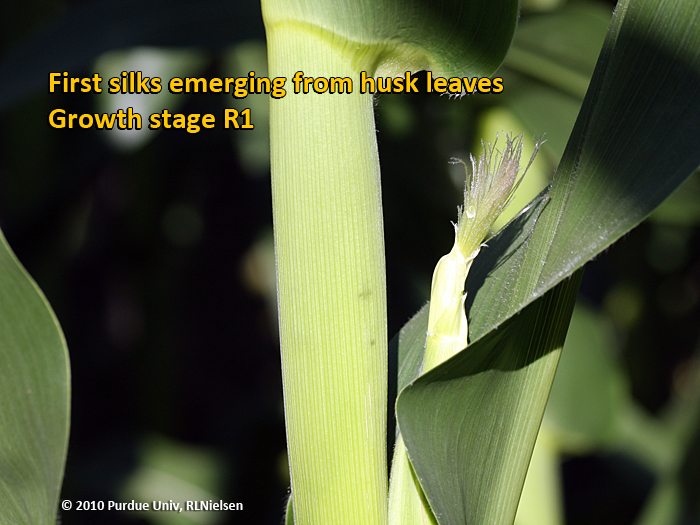
Silks emerging from husk leaves.
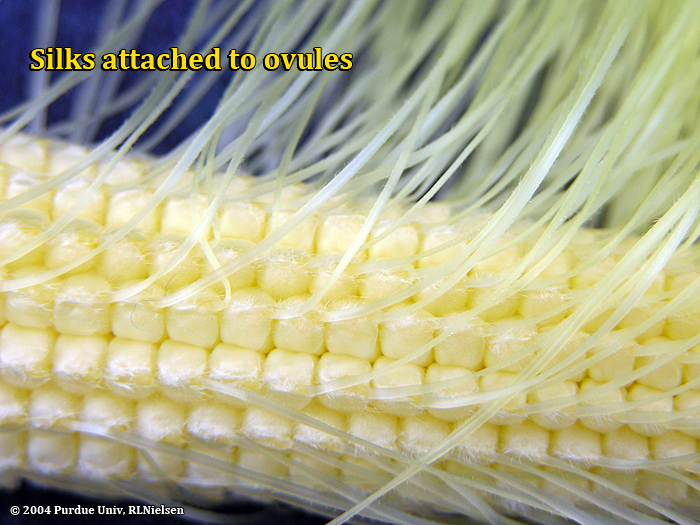
Silks attached to ovules on an ear of corn.
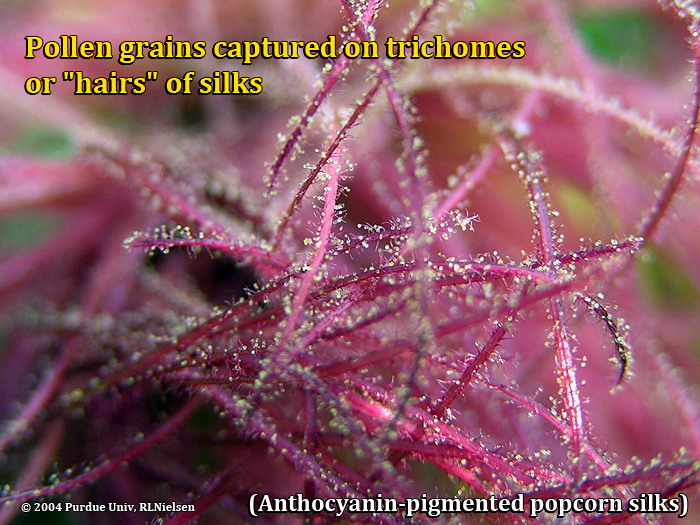
Pollen grains captured on silk trichomes.
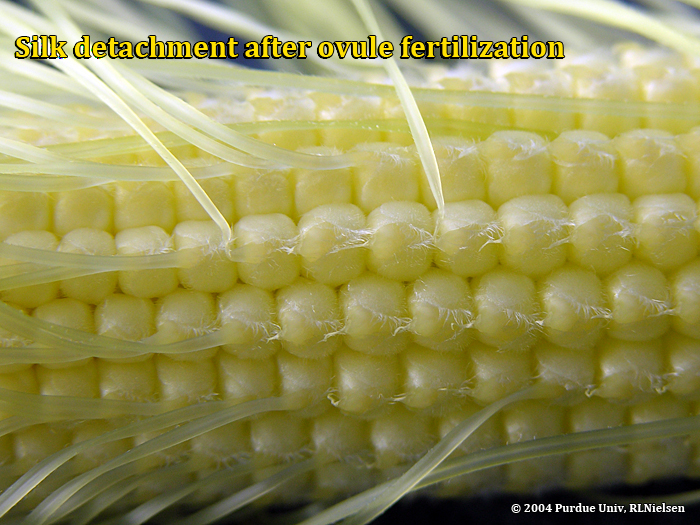
Silk detachment from fertilized ovules.
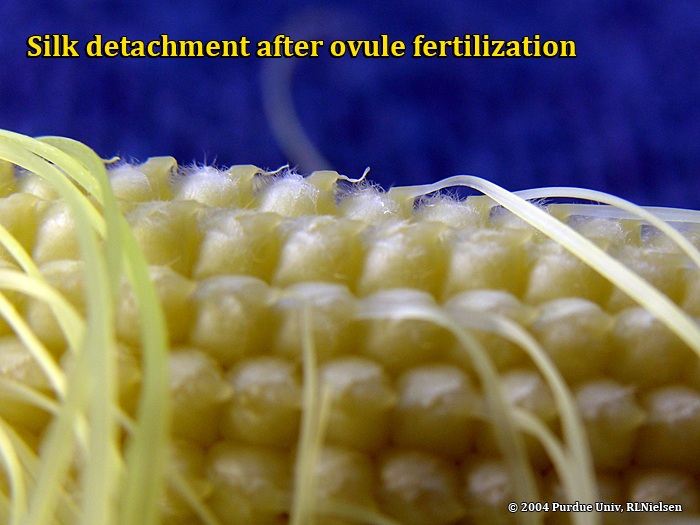
Silk detachment from fertilized ovules.
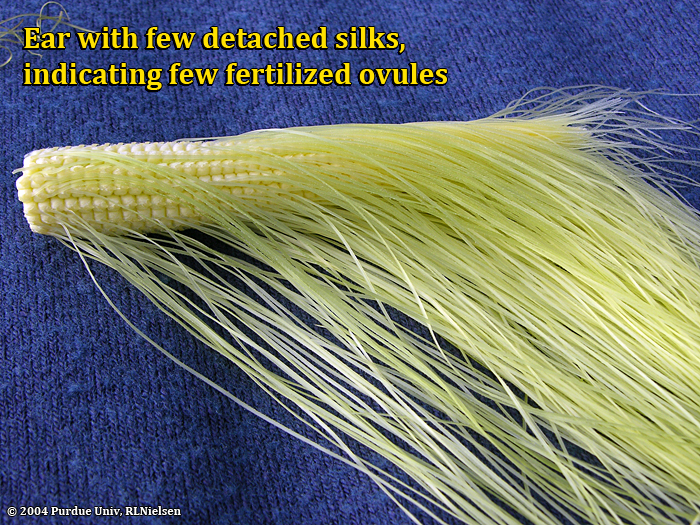
Ear with few detached silks, indicating few
fertilized ovules.
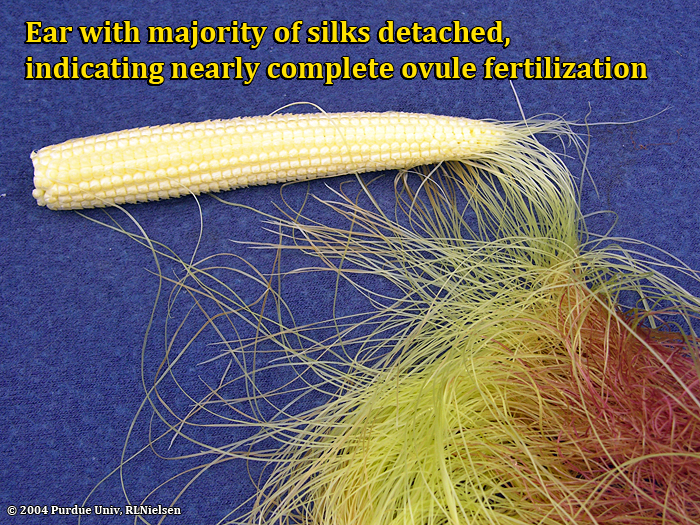
Ear with majority of silks detached, indicating nearly complete fertilization of ovules.