Bulletin Number B
Performance of Commercial Grain Sorghum Hybrids in Indiana, 1998
T. Lemming, G. Ejeta, and J.
Axtell
Sorghum has received serious consideration as a grain crop in some Indiana locations.
With adapted hybrids and proper management, sorghum will usually produce higher returns
than either corn or soybeans on certain soil types and low-rainfall areas, especially if
the grain is fed to livestock (see Purdue Extension Publication AY-198). This publication
provides producers, seedsmen, extension educators and others with information on sorghum
hybrid performance.
A total of 30 hybrids from the 6 companies listed in Table 4
were evaluated at three locations in Indiana. One of the earliest sorghum hybrids to be
developed, RS610, and a Purdue cultivar of good agronomic quality and wide adaptation,
P954063, were used in each year's trials as standards against which newer commercial
hybrids can be compared.
LOCATION OF TRIALS
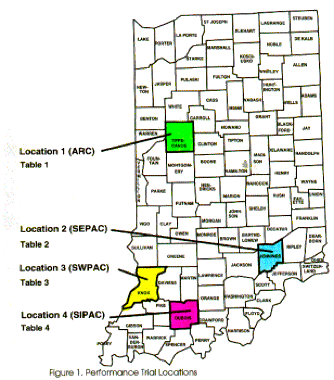
| The four trial locations are shown in Figure 1. Location 1
(Tippecanoe County). The trial was at the Purdue University Agronomy Research Center (ARC)
near West Lafayette, on a Chambers silty clay loam soil.
Location 2 (Jennings County). This location is at the Southeast Purdue
Agricultural Center (SEPAC) near North Vernon, on a Avonburg silt loam soil.
Location 3 (Knox County). The trial was at the Southwest Purdue Agricultural
Center (SWPAC) near Vincennes, on a Ross loam soil.
Location 4 (Dubois County). The trial was at the Southern Indiana Purdue
Agricultural Center (SIPAC) near Dubois, on Tilsit silt loam soil. |
 |
TRIAL PROCEDURES
Plots. The plots were arranged in a randomized complete block design with three
replications at each location. Each plot consisted of two rows 16 feet long with 30-inch
row spacing.
Planting. The seedbeds were prepared by conventional tillage. Location 1 was
planted with a John Deere Max-emerge planter. Locations 3 and 4 were planted with a
two-row cone planter. The seeding rate was approximately 10 seeds per foot. Plant
population was thinned to six plants per foot shortly after emergence resulting in
approximately 100,000 plants per acre.
Cultural Practices. Ramrod-atrazine pre-plant or pre-emerge herbicide
combination was used for weed control in all locations. Each location was cultivated at
least once and hand weeded as necessary. An optimum soil fertility level was maintained in
order to allow maximum hybrid performance.
Harvest. At the two southern-most locations, heads from all plants in a 10-foot
section of each row of the two-row plot were hand harvested. The Tippecanoe County trial
was harvested with a plot combine. After threshing, grain moisture was recorded and yields
adjusted to 13.5 percent moisture.
Information recorded. Half-bloom, plant height and percent bird damage were
recorded during the growing season. Half-bloom is the number of days from planting
until 50 percent of the plants have shed pollen halfway down the head. Physiological
maturity (cessation of dry matter accumulation in the grain) is reached 35-40 days after
half-bloom. Plant height is the average height, in inches, from the soil surface to
the tip of the head at maturity. Bird damage was measured by visual estimation of
the percentage of grain yield lost to bird feeding.
RESULTS
Results of the 1998 performance tests are presented by location in Tables 1 through 3.
General conditions present at each location are given below.
Location 1 (Tippecanoe County) Table 1. The hybrids
were planted on May 28 and June 23. Rainfall from April through October totaled 28.67
inches. No lodging or bird damage was observed. A very wet June (8.41 inches of rain),
caused flooding. The original trial had to be replanted, hence the second planting date
.After this start the growing season was fair. Growing degree day (GDD) accumulation
totaled 3735. Yields averaged 109 bu/acre 6095 lb.), with the highest yielding hybrid
averaging 130 bu/acre (7269 lb.). This was one of the lowest yielding tests in the last 17
years, equaling the 1988 trial.
Location 2 (Jennings County). No trial was established this year , because of
the wet spring.
Location 3 (Knox County) Table 2. The hybrids were
planted on June 25. Rainfall from April through October totaled 36.93 inches. Extremely
wet conditions in May and June, followed by normal to drought like conditions in the
following months, stressed the crop to some extent. The trial was also damaged by birds,
with the average amount of bird feeding surpassing 20 percent of the potential yield on
some hybrids, resulting in the higher than acceptable variability (CV). Growing degree day
(GDD) accumulation totaled 4175. Yields averaged 85 bu/acre (4733 lb.), with the highest
yielding hybrid averaging 111 bu/acre (6328 lb.).
Location 4 (Dubois County) Table 3. The hybrids were
planted on June 25. Rainfall from April through October totaled 31.62 inches. A small
amount of deer damage was observed for some of the hybrids. An early wet season
contributed to the late planting date.. Growing degree day (GDD) accumulation totaled
3990. Yields averaged 118 bu/acre (6634 lb.), with the highest yielding hybrid averaging
144 bu/acre (8089 lb.).
DISCUSSION
An analysis of variance was conducted and the Least Significant Difference (LSD)
computed at the 5 percent level of significance. The LSD indicates how much one entry must
differ from another entry within a location to be reasonably certain that it is a true
difference. If the yield difference between the two hybrids is less than the LSD, then
other factors must be considered in deciding which hybrids to grow, such as days to
flowering. The LSD is given in the same units as the average (i.e. pounds per acre, etc.).
An asterisk (*) beside a yield average on a performance table indicates that the yield is
not significantly different from the highest yield in the table.
The coefficient of variation (CV) was determined for the traits measured. The CV
measures the amount of experimental error relative to the average and indicates how much
error was present. When yields are high relative to the experimental error, the CV will be
small.
Growing degree-day (GDD). A modified 50 scale was used. GDD equals daily mean
minus 50 (below 50 adjust to 50, above 86 adjust to 86). April 1 through October 31 was
recorded.
Participating companies. The companies participating in the 1998 performance
trials are listed in Table 4.
ACKNOWLEDGMENTS
The Purdue University Sorghum Project acknowledges the assistance of the following
individuals and their staff for help with the field preparation for the 1998 Commercial
Grain Sorghum Performance Trial.
Jim Beaty, Superintendent - ARC
Don Biehle, Superintendent - SEPAC
Melborn Lang, Superintendent - SWPAC
Frank Potts, Superintendent - SIPAC
Credit is given to Philip Hess for writing the computer software, Vartest, used in
preparing the performance tables. Sincere gratitude is also expressed to Bill Foster,
Karen Clymer, Dan Weisenberger, and Phil DeVillez for their overall support of the 1998
Sorghum Yield Testing program.
COPYRIGHT INFORMATION
This information, protected by copyright by the Purdue Research Foundation, is
presented under authority granted the Indiana Agriculture Research Programs to conduct
performance trials, including interpretation of data to the public, and does not imply
endorsement or recommendation by Purdue University. Permission is granted to reproduce
tables only in their entirety provided the source is referenced and the data are not
rearranged, manipulated or reinterpreted. A conspicuous disclaimer which states
"endorsement or recommendation by Purdue University is not implied" must
accompany any information reproduced. Additional copies of this publication are available
to Indiana residents through their local Purdue Cooperative Extension Office or Media
Distribution.