29 June 2026
URL: kingcorn.org/news/Knee-high-July4.html
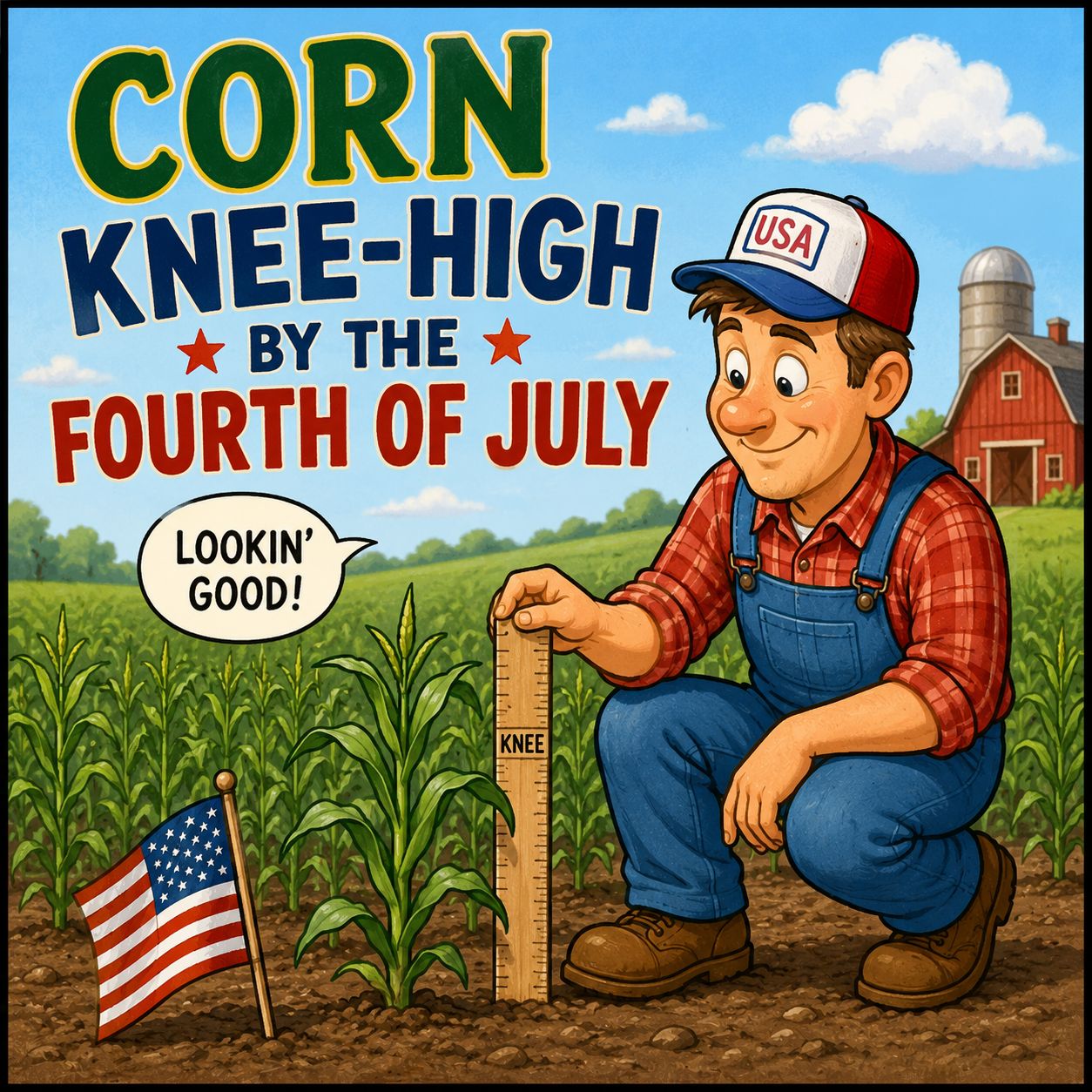
"Knee-high by the Fourth of July?"
A Quaint Adage, But That's About All
R.L. (Bob) Nielsen
Professor Emeritus & Retired Extension Corn Specialist
Agronomy Dept., Purdue Univ.
West Lafayette, IN 47907-2054
Email address: rnielsen at purdue.edu
Note: All graphics are © Purdue Univ. & were generated using ChatGPT AI chatbot.
- The phrase is an old folk proverb that entered the written record gradually in the mid-1800s.
- The phrase has a historical agronomic basis, it's just not relevant today.
- Public interest in the phrase can be filed under the category: "Perennial Folksy Questions About Corn That News Media Like to Write About".
So what's the deal with this phrase? Is it based on agronomic fact? Is it relevant for modern corn production today?
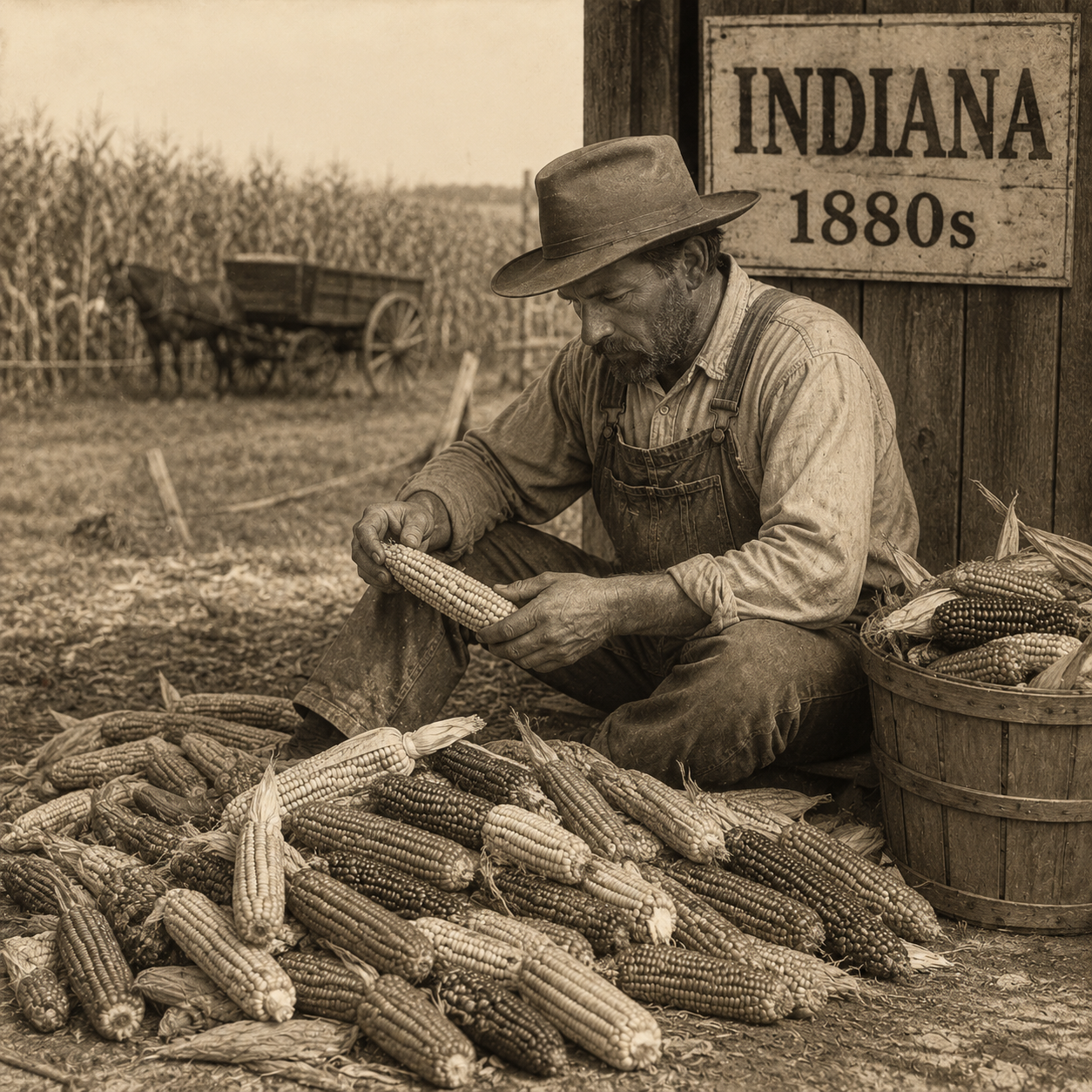
Let me set the scene by reminding you that the open-pollinated corn varieties planted by our farming ancestors in the 1800s and early 1900s were not exactly the same as today's hybrid corn varieties. Prior to the late 1930s, U.S. farmers planted corn with seed (aka kernels) from ears they had self-selected and saved from the previous year's harvest. They would carefully select ears of corn that were large and uniformly populated with kernels, or ears whose kernels were the desired color (yellow, white, red, etc.), or ears from plants that remained strongly upright until harvest, or ears from plants that were positioned at just the right height for hand-harvesting (not too high, not too low), or those from plants that had tolerated diseases well, with the hope that the crop planted using that saved seed would mimic the characteristics upon which the ears had been selected. Every fall at harvest, farmers repeated the self-selection of seed corn for the next year's crop. There was no purposeful hybridization. There was no controlled pollination. There were no seed salesmen driving up and down the country roads hawking their varieties. On-farm storage of the saved ears of corn was often lacking for uniform control of storage temperature and humidity, so seed quality the following spring at planting time was often less than optimum and quite variable.
Back in the 1800s, farmers did not plant their open-pollinated varieties anywhere near as early as we do today using modern hybrid corn. Throughout the heart of the U.S. Corn Belt, it was not uncommon for corn to be planted late May through early June, certainly not much earlier than mid-May. The reasons? 1) It took longer to work ground in the spring with horse-drawn, small-sized tillage tools than today's larger tractor-powered equipment. 2) The heavy, poorly drained, yet-to-be-tiled soils, especially in IL, IN, and OH took much longer to dry and warm in the spring following a harsh winter in order to allow for optimum tillage and planting. 3) Germination and early plant vigor of the open-pollinated varieties were often not the best, partially due to the often inadequate ways farmers stored their seed corn from harvest to planting. Consequently, many farmers waited until the soils warmed significantly before planting (influenced by point #2), which often meant late May - early June.
Modern hybrids planted near the end of May in central Indiana will usually reach V6-V8 leaf stages (Nielsen, 2019) by the 4th of July as predicted by growing degree day (GDD) accumulations (Andresen et al., 2015), which is roughly knee-high (depending of course on whose knee was used as the reference). It would have often been a tough "row to hoe" for the old open-pollinated varieties to similarly reach V6-V8 by the 4th of July because of point #3 above.
Modern hybrids planted late in central IN and reaching V6-V8 by the 4th of July would be expected to reach physiological maturity by late October or early November based on GDD accumulations (Andresen et al., 2015). That maturity date puts the crop squarely at risk for a killing fall frost for that part of Indiana. The old open-pollinated varieties tended to be quite a bit longer maturing than today's hybrids. Even during the past 40+ years in Indiana, it was not uncommon to see 118-120 day relative hybrid maturities (Nielsen, 2025) grown by farmers when I started my Purdue Extension career in 1982. Today it is rare to see Indiana farmers growing hybrids much later than 115-day relative maturity and mostly in the 108- to 113-day relative maturity. That change was a result of plant breeders successfully increasing the yield potential of shorter-season hybrids to equal or nearly equal fuller-season hybrid yield potential with the benefit of drier grain at harvest and lower grain drying expenses.
The combined influences of 1) untreated, variably vigorous seed corn, 2) often inadequate or at the very least variable soil nutrient availability (manure-based fertility), 3) often poorer weed control, and 4) varieties that were more full-season maturity than today meant that later planted corn in the 1800s and early 1900s often struggled to reach "knee-high by the 4th of July". If the corn failed to reach that V6-V8 stage by the 4th of July, the risk of the crop being exposed to killing fall freezes before it reached physiological maturity was quite high.
The End of a Long-Winded Story
Our farmer ancestors in the U.S. Corn Belt learned over time that when their open-pollinated corn crop, typically planted late May to early June, reached at least "knee-high by the 4th of July", the crop had a good chance of reaching physiological maturity safely before the occurrence of a killing fall freeze. Today's modern hybrids, with much improved seed and seedling vigor, are typically planted much earlier (late April - early May) than open-pollinated varieties were a century ago and so commonly will be 48-72 inches (122-183 cm) tall by the 4th of July and reach physiological maturity by late September, well ahead of normal killing fall freezes. Consequently, this is why the popular phrase "Knee-high by the Fourth of July" is a quaint adage, but mostly irrelevant to today's corn production systems.
That's my opinion and you are welcome to it.
References
Andresen, Jeff, Jim Angel, Larry Biehl, Roger Elmore, Beth Hall, Chad Hart, Tom Hultquist, Ray Massey, Chris Panza, Brian Raub, Martha Shulski, Dennis Todey, Melissa Widhalm, Ray Wolf. 2015. Corn GDD, a U2U Decision Support Tool. Midwest Regional Climate Center, Purdue University. https://mrcc.purdue.edu/tools/corngdd [URL accessed June 2026].
Nielsen, RL (Bob). 2019. Determing Corn Leaf Stages. Corny News Network, Purdue University Extension. http://www.kingcorn.org/news/timeless/VStageMethods.html [URL accessed June 2026].
Nielsen, RL (Bob). 2020. Heat Unit Concepts Related to Corn Development. Corny News Network, Purdue University Extension. http://www.kingcorn.org/news/timeless/HeatUnits.html [URL accessed June 2026].
Nielsen, RL (Bob). 2025. Interpreting Corn Hybrid Maturity Ratings in the U.S. Corny News Network, Purdue University Extension. http://www.kingcorn.org/news/timeless/HybridMaturity.html [URL accessed June 2026].
Popik, Barry. 2012. "Knee-high by the Fourth of July" (corn-growing adage). The Big Apple; an etymological dictionary. https://barrypopik.com/blog/knee_high_by_the_fourth_of_july_corn_growing_adage [URL accessed June 2026].
END OF DOCUMENT