

 Follow @PurdueCornGuy
June 2015
URL: http://www.kingcorn.org/news/timeless/HailDamageYoungCorn.html
Recovery From Hail Damage to Young Corn
R.L. (Bob) Nielsen
Agronomy Dept., Purdue Univ.
West Lafayette, IN 47907-2054
Email address: rnielsen
at purdue.edu
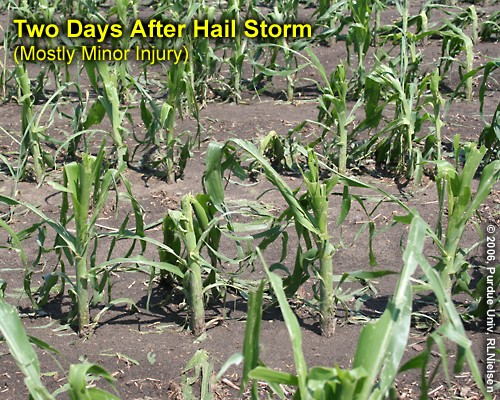
Click on image to open a larger version.
 arly summer thunderstorms
often include not only torrential rainfall, but also damaging hail. Looking out the kitchen window the morning after
such a storm at a field damaged by hail can be one of the most disheartening feelings in the world to
a corn grower. The challenge is to separate emotion from reality when assessing actual damage to plants and estimating recovery of a hail-damaged field.
arly summer thunderstorms
often include not only torrential rainfall, but also damaging hail. Looking out the kitchen window the morning after
such a storm at a field damaged by hail can be one of the most disheartening feelings in the world to
a corn grower. The challenge is to separate emotion from reality when assessing actual damage to plants and estimating recovery of a hail-damaged field.
Yield loss in corn due to hail damage results primarily from 1) stand reduction caused by plant death and 2) leaf area reduction caused by hail damage to the leaves. Assessing the yield consequences of hail damage in corn therefore requires that the severity of each of these factors be estimated.
Assessing Plant Survival
As with most early-season problems, evaluation of hail-damaged fields should not be attempted the day after the storm occurs because it can be very difficult to predict survivability of damaged plants by simply looking at the damage itself. Young corn has an amazing capacity to recover from early season damage but patience is required to allow the damaged plants enough time to visibly demonstrate whether they will recover or not. Damaged but viable plants will usually show noticeable recovery from the whorl within 3 to 5 days with favorable weather and moisture conditions.
One thing you can do shortly after the storm, however, is to evaluate the relative condition of the main growing point area of the stalk. The growing point, or apical meristem, of a young corn plant is an area of active cell division located near the tip of the pyramid-shaped top of the stalk tissue inside the stem of the plant (Nielsen, 2008a). The growing point region is important because it is responsible for creating all the leaves and the tassel of a corn plant.
Initially, the growing point is located below ground but soon elevates above ground beginning at about the 5th leaf collar stage. Slicing a stalk down the middle and looking for the pyramid-shaped upper stalk tissue can identify the vertical position of the growing point. If hail has damaged the growing point or cut off the stalks below the growing point, then those plants should be counted as victims and not survivors.
Remember that yield loss in corn is not directly proportional to the reduction in the number of plants per acre when the damage occurs early in the growing season. The surviving plants that surround a missing plant compensate by increasing their potential kernel numbers or by developing a second ear. Figure 1 illustrates corn grain yield response to final plant population, averaged over 54 field-scale trials involving a range of hybrids and soils around Indiana in recent years. The results of those trials suggest that maximum grain yield occurs at about 32,000 plants per acre (ppa) on soils with adequate soil moisture availability. Relative grain yield loss for final populations near 24,000 ppa (equal to a 25% reduction in population) is less than 4% of maximum grain yield. The crop insurance industry uses their own data to assess yield loss due to plant mortality, but the concept is the same... yield loss in corn is not directly proportional to the reduction in the number of plants per acre when the damage occurs early in the growing season.
Click for  Hail Damage Photo Gallery
Assessing Defoliation Severity
Leaf damage by hail usually looks worse than it really is. Tattered leaves that remain green and connected to the plant will continue to photosynthesize. It takes a practiced eye to accurately estimate percent leaf death by hail. With that caution in mind, percent damage to those leaves exposed at the time of the hailstorm can be estimated and used to estimate yield loss due to defoliation alone.
The effects of leaf death on yield increases as the plants near silking, and then decreases throughout grain fill. Therefore, the grower needs to determine the leaf stage of the crop when the hail damage occurred. This can be challenging depending on the severity of the damage to the plants by the hail.
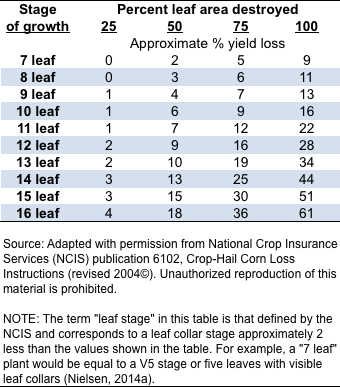
Remember that leaf staging for the purposes of hail damage assessment is slightly different than the usual leaf collar method. The yield loss estimates listed in Table 1 are based on leaf stages as defined by the “droopy leaf” method (Nielsen, 2014a). If you are walking damaged fields many days after the storm, you can stage the crop that day and backtrack to the day of the storm by assuming that leaf emergence in corn occurs at the rate of about 1 leaf every 82 GDDs from emergence to V10 (ten fully visible leaf collars) or every 50 GDDs from V10 to the final leaf (Nielsen, 2014b).
Once percent leaf damage and crop growth stage have been determined, yield loss can be estimated by using the defoliation chart provided below in Table 1. This table is a condensed version of the season-long table published in the Purdue Extension publication ID-179, Corn and Soybean Field Guide.
Click for
Hail Damage Photo Gallery
Assessing Consequences of Whorl & Stem Bruising
The eventual yield effects of severe bruising of leaf tissue in the whorl or the stalk tissue itself in older plants are quite difficult to predict. Consequently, it can be difficult to determine whether to count severely bruised plants as survivors or whether they should be voted off the field. The good news is that observations reported from an Ohio on-farm study suggest that bruising from hail early in the season does NOT typically result in increased stalk lodging or stalk rot development later in the season (Mangen & Thomison, 2001).
Early season bruising of leaf tissue or stem tissue may, however, have other consequences on subsequent plant development; the occurrences of which are hard to predict. Areas of bruised whorl leaf tissue often die and can then restrict continued expansion of whorl leaves, resulting in the type of ‘knotted’ whorl reminiscent of frost damaged plants. These same bruised leaves would be more susceptible to secondary invasion by bacteria contained in splashed soil that might have been introduced into the damaged whorls if the hailstorm was accompanied by driving rains.
If the plant tissue bruising extends as deep as the plant’s growing point, that important meristematic area may die; thus killing the main stalk and encouraging the development of tillers. If the plant tissue bruising extends into the area near, but not into, the growing point; subsequent plant development may be deformed in a fashion similar to any physical damage near the hormonally active growing point (stinkbug, stalk borer, drill bits used by malicious agronomists).
Click for
Hail Damage Photo Gallery
Example of Assessing Damage
Let's say that your field of corn was at the 7-leaf stage (approximately V5 by the leaf collar method) when hail damage occurs. After walking the field several days later, you determine only 24,000 of your original 32,000 plants per acre will survive the hail damage (which to most of us would look devastating). Your surviving stand of 24,000 now has an upper yield potential of 96.5% of “maximum” (Fig. 1). Therefore, the yield loss due to plant death itself would be about 3.5%.
Let’s also assume that you estimate the average percent leaf death by defoliation to be 50% (which to most of us would look devastating). The combination of leaf stage and percent defoliation would translate into an additional 2% yield loss (Table 1), resulting in a total estimated yield loss due to both stand reduction and defoliation of approximately 5.5%.
Fig. 1. Relative yield response to final plant population in Indiana.
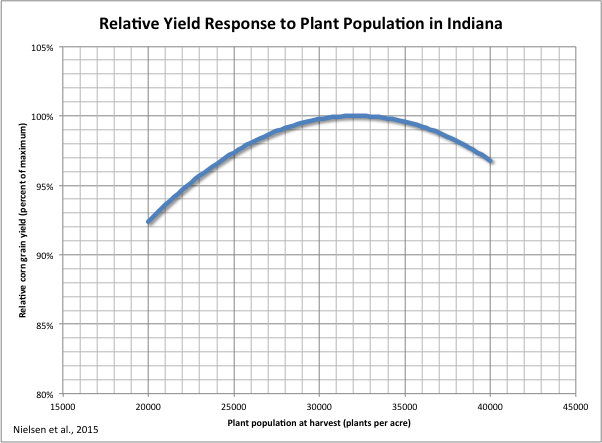
Table 1. Estimates of percent yield loss in corn due to leaf
defoliation at selected leaf stages.
Related References
Klein, Robert and Charles Shapiro. 2011. Evaluating Hail Damage to Corn. Univ. of Nebraska Extension Pub. #EC126. http://www.ianrpubs.unl.edu/live/ec126/build/ec126.pdf. [June 2015].
Lauer, Joe. 2014. Hail Damage on Corn. Corn Agronomy, Univ of Wisconsin. http://corn.agronomy.wisc.edu/Management/L039.aspx. [URL accessed June 2015].
Lee, Chad. 2007. Estimating Hail Damage in Corn. Univ. of Kentucky Extension. Pub. #AGR-194. http://www2.ca.uky.edu/agc/pubs/agr/agr194/agr194.pdf. [URL accessed June 2015].
Mangen, Todd and Peter Thomison. 2001. Early Season Hail Damage in Corn: Effects of Stalk Bruising and Tied Whorls. Ohio State Univ. Cooperative Ext. Service Special Circular 179-01. [On-Line]. Available at http://ohioline.osu.edu/sc179/sc179_16.html [URL accessed June 2015].
Nielsen, RL (Bob). 2008a. Growing Points of Interest. Corny News Network, Purdue Univ. [On-Line]. Available at http://www.kingcorn.org/news/timeless/GrowingPoints.html [URL accessed June 2015].
Nielsen, RL (Bob). 2008b. Tips for Staging Corn with Severe Leaf Damage. Corny News Network, Purdue Univ. [On-Line]. Available at http://www.kingcorn.org/news/timeless/VStagingTips.html. [URL accessed June 2015].
Nielsen, RL (Bob). 2014a. Determining Corn Leaf Stages. Corny News Network, Purdue Univ. [On-Line]. Available at http://www.kingcorn.org/news/timeless/VStageMethods.html [URL accessed June 2015].
Nielsen, RL (Bob). 2014b. Use Thermal Time to Predict Leaf Stage Development in Corn. Corny News Network, Purdue Univ. [On-Line]. Available at http://www.kingcorn.org/news/timeless/VStagePrediction.html [URL accessed June 2015].
Nielsen, R.L. (Bob), Jason Lee, & Jim Camberato. 2015. Yield Response to Plant Population for Corn in Indiana. Research Update, Agronomy Dept, Purdue Univ. http://www.kingcorn.org/news/timeless/SeedingRateGuidelines.html. [URL accessed June 2015].
Thomison, Peter. 2013. Hail damage to corn varies depending on growth stage. C.O.R.N. Newsletter, Ohio State Extension. http://agcrops.osu.edu/corn/newsletters/2013/2013-19/hail-damage-to-corn-varies-depending-on-growth-stage. [URL accessed June 2015].
Vorst, J.J. 1993. Assessing Hail Damage to Corn. Purdue Univ Cooperative Ext. Service Publication NCH-1. [On-Line]. Available at http://www.ces.purdue.edu/extmedia/NCH/NCH-1.html [URL accessed June 2015].
 Comments or questions? Send