October 2019
URL: http://www.kingcorn.org/news/timeless/TasselEars.html
Tassel Ears in Corn
R.L. (Bob) Nielsen
Agronomy Dept., Purdue Univ.
West Lafayette, IN 47907-2054
Email address: rnielsen at purdue.edu
Twitter: @PurdueCornGuy
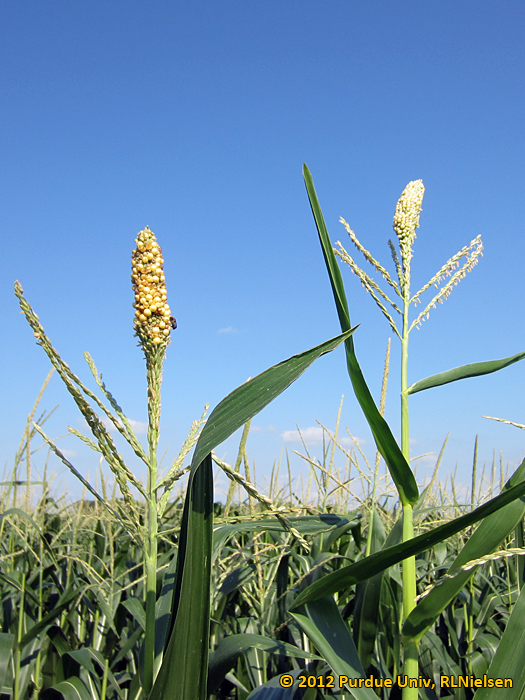
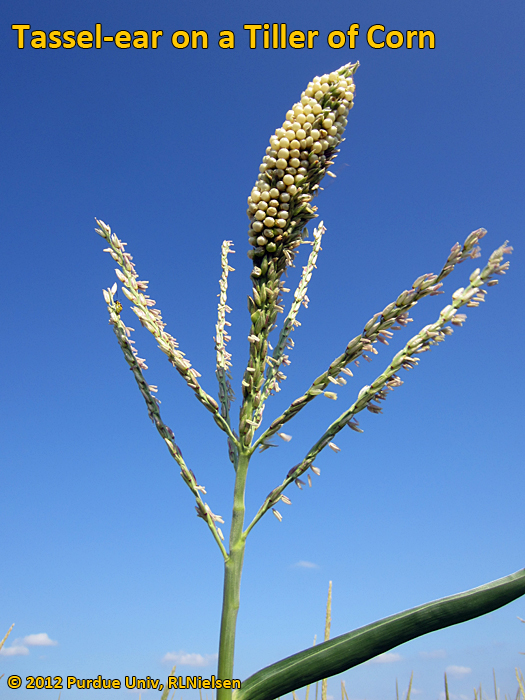
 eems like every year some fellow walks into the Chat 'n Chew Cafe carrying an odd-looking tassel that is part tassel and part ear to show off to the guys over at the corner table. Much discussion always ensues over the causes of tassel ears, but the usual consensus is that it falls into the general category of corny oddities and is rarely a yield-influencing factor.
The male and female reproductive organs of a corn plant are contained in physically separate unisexual flowers (a flowering habit called "monoecious" for you trivia fans.) The tassel represents the male flower on a corn plant, while the ear shoots represent the female flowers. Interestingly, both reproductive structures initiate as perfect (bisexual) flowers, containing both male and female reproductive structures. Soon after each each reproductive structure has initiated, the female components (gynoecia) of the tassel and the male components (stamens) of the ear shoots abort, resulting in the unisexual flowers (tassels and ears) we come to expect.
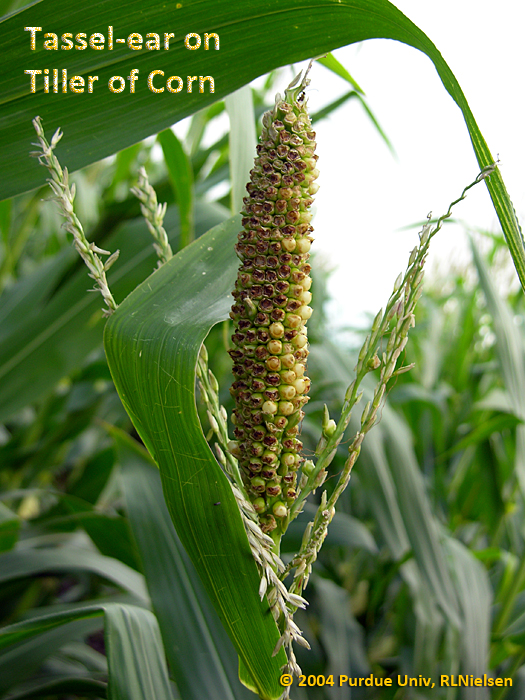
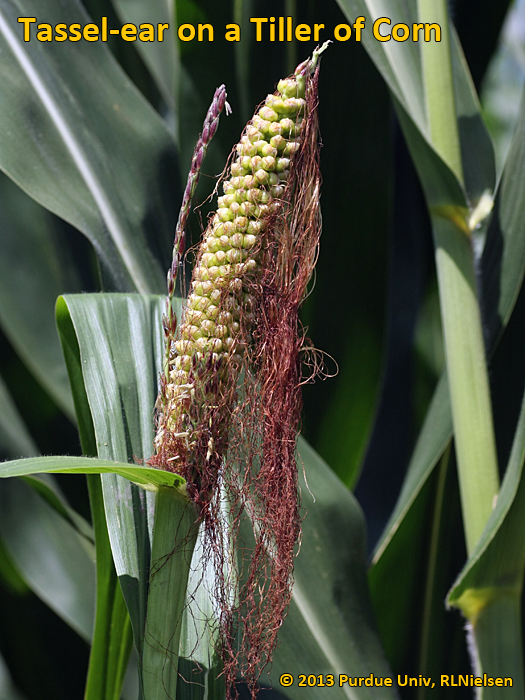
Once in a while, some or many of the female flower parts survive and develop on the tassel, resulting in individual kernels or partial ears of corn in place of part or all of the tassel. The physiological basis for the survival of the female floral parts on the tassel is likely hormonally-driven, but the environmental "trigger" that alters the hormonal balance is not known. There are also known genetic mutations that alter normal tassel development by allowing the female flower components to survive.
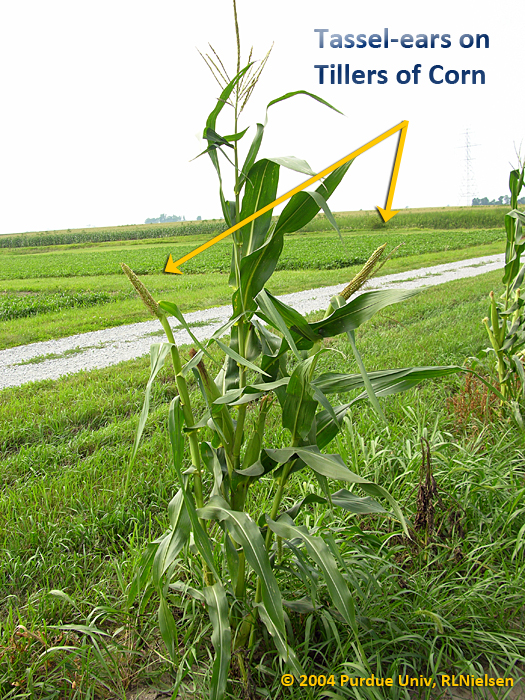
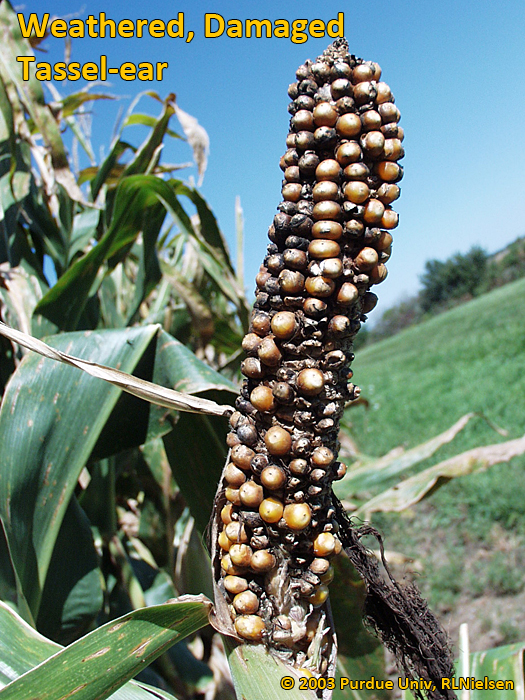
A "tassel ear" is an odd-looking affair and is found almost exclusively on tillers or "suckers" of a corn plant along the edges of a field or in otherwise thinly populated areas of a field. It is very uncommon to find tassel ears on the main stalk of a corn plant.
Without a protective husk covering, the kernels that develop on tassel ears are at the mercy of weathering and hungry birds. Consequently, harvestable, good quality, grain from tassel ears is rare.
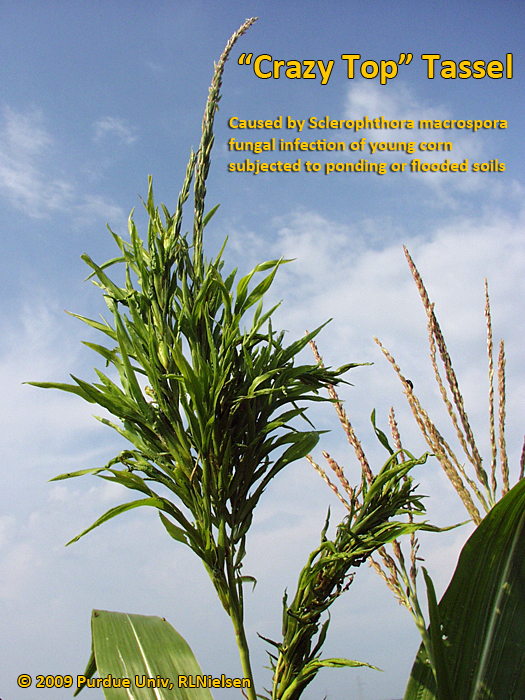
Some folks lump the tassel ear symptom into the same category as the malformed tassel symptom of the so-called "crazy top" disease. These two odd tassel symptoms are not related and, in fact, look totally different. The "crazy top" disease is caused by infection of young corn plants during ponding events by the soil-borne fungus Sclerophthora macrospora that eventually expresses itself by altering normal tassel development (and sometimes ear shoot development) into a mass of leaf tissue.
Click image to view larger version in a popup window. Left or right arrow on your keypad will cycle through the popup images.
Related Reading
Bonnett, O.T. 1948. Ear and Tassel Development in Maize. Annals of the Missouri Botanical Garden 35:269-287, Missouri Botanical Garden Press. https://www.jstor.org/stable/pdf/2394693.pdf [URL accessed Oct 2019]
Cheng, Ping-chin and Dayaker R Pareddy. 1994. Morphology and Development of the Tassel and Ear. in Freeling & Walbot, eds., The Maize Handbook, pp 37-47. Springer-Verlag, New York, Inc.
Iriarte, Fanny and Alison Robertson. 2009. Signs of Crazy Top in Corn. Integrated Crop Management News, Iowa State Univ. Extension. http://www.extension.iastate.edu/CropNews/2009/0706robertsoniriarte.htm [URL accessed Oct 2019].
Luft, Nanticha. Date unknown. Tassel Ears in Corn. Crop Focus, Pioneer Seeds. https://www.pioneer.com/us/agronomy/tassel-ears-cropfocus.html [URL accessed Oct 2019]
Nielsen, R.L. (Bob). 2003. Tillers or “Suckers” in Corn: Good or Bad? Corny News Network, Purdue Univ. http://www.kingcorn.org/news/articles.03/Tillers-0623.html. [URL accessed Oct 2019].
Pioneer. 2017. Do Corn Tillers Hurt or Help Yields? GenTech Seeds Pty Ltd, Australia. https://www.pioneerseeds.com.au/corn-silage/product-information/silage-technical-insights/do-corn-tillers-hurt-or-help-yields.html [URL accessed Oct 2019]
Sweets, Laura. 2011. Crazy Top of Corn. Integrated Pest & Crop Management, Univ of Missouri Extension. http://ipm.missouri.edu/ipcm/2011/5/Crazy-Top-of-Corn [URL accessed Oct 2019].
Thomison, Peter. 2017. Does Tillering Impact Corn Yield? Agronomic Crops Network, Ohio State University Extension https://agcrops.osu.edu/newsletter/corn-newsletter/2017-24/does-tillering-impact-corn-yield [URL accessed Oct 2019].
Thomison, Peter, David Lohnes, Allen Geyer, and Marguerite Thomison. 2015. Tassel Ears. Troubleshooting Abnormal Corn Ears, Ohio State Univ. Extension. https://u.osu.edu/mastercorn/tassel-ears/ [URL accessed Oct 2019]