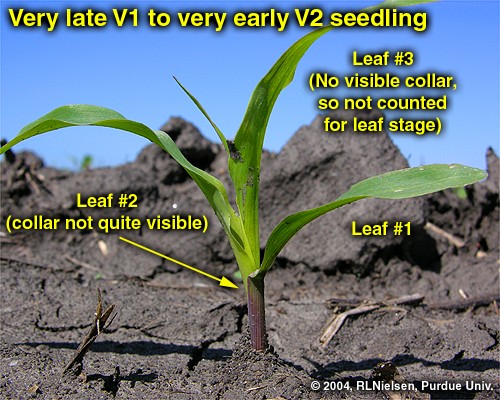
Very late V1 to early V2 corn plant.
Recovery from early season damage to corn is strongly dependent on the health of the main (apical) growing point region following the damage.
 here is something about 30 mph winds and sand/grit/soil blasting across corn fields at seedling height that makes one curious about the ability of corn to recover from early season damage. The same can be said following a thunderstorm accompanied by strong winds and damaging hail (Nielsen, 2015). Whenever corn is damaged early in the growing season, growers are sometimes faced with the decision of whether or not to replant the field.
One of the most important, and most difficult, steps in making a replant decision is estimating the surviving plant population in the field. Corn is remarkably resilient to aboveground damage early in the season, yet growers often underestimate the ability of corn to recover from such damage. Consequently, much of the replanting that occurs each year is a waste of money and effort. Use the worksheet in my replant publication (AY-264-W) to estimate yield and dollar returns to corn replanting.
The health and condition of the corn plant’s growing point (apical meristem) plays a major role in determining whether a damaged corn plant will recover or not. A plant damaged aboveground but with a healthy, undamaged growing point will usually survive. However, damage to the growing point area will either kill the plant or severely stunt its recovery.
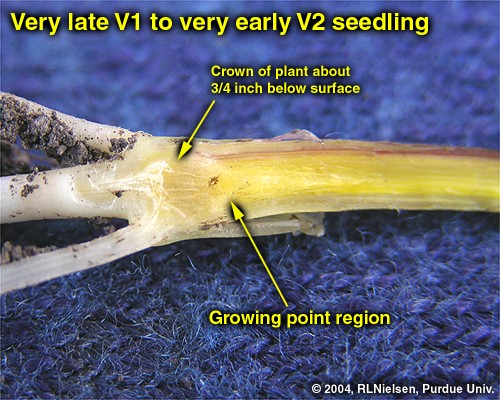 What we refer to as "growing points" are technically known as "meristems". These are the physiologically active regions of the plant where cell division and cell differentiation occur. Once the kernel germinates, the shoot apical meristem of the seedling begins to initiate the primordia for all the leaves of the corn plant except for the 4 to 5 leaves that formed in the embryo of the kernel prior to physiological maturation the previous growing season.
Following the initiation of the final, uppermost, leaf primordium at approximately growth stage V5, the apical meristem initiates the tassel primordium. Interestingly, the uppermost harvestable ear initiates at one of the axillary meristems at about the same time as the tassel does at the apical meristem. Once the tassel has been initiated, the apical meristem by definition ceases to exist.
Tip: For a refresher on determining leaf stages in corn, see http://www.kingcorn.org/news/timeless/VStageMethods.html.
Anatomically, the growing point region is located near the top of the young plant’s stalk tissue. Prior to stalk internode elongation, the growing point is initially located 1/4 to 3/4 inch below the soil surface, near the crown of young seedlings from growth stage VE (emergence) to about V4.
Consequently, until V4 or V5 all the plant tissue you see above ground is either expanded leaves or rolled up leaves in the whorl. During VE to about V5, there is no stalk tissue yet above the soil surface. That's why young corn can tolerate so much aboveground damage and still recover nicely.
The lowermost stalk internodes begin to elongate shortly before V5, almost like stretching out a telescope beginning with the base sections, and the stalk tissue plus the growing point slowly elevate to above the soil surface. From this point forward, the apical meristem (actually, the tassel after V5) and all of the axillary meristems (source of ear shoots) become increasingly exposed and vulnerable to aboveground damage.
Prior to about V5, while the growing point is below ground, corn can tolerate quite a bit of aboveground injury from “single event” kinds of damage like frost, hail, wind, cutworm feeding, sandblasting, tire traffic, 28% N solution burn, etc. However, repeated injury to young plants (e.g., multiple days of sandblasting) or extended periods of sub-optimal growing conditions after the occurrence of aboveground damage (e.g., cold temperatures, cloudy days) may prevent photosynthetic recovery (renewal of green leaves) long enough to eventually kill the plant even though the growing point is technically not injured.
While corn younger than about V5 can tolerate a fair amount of aboveground frost damage to exposed leaf tissue, lethal cold temperatures (28F or less for several hours) can “penetrate” the upper soil surface (especially dry soils) and damage or kill the growing point of a young corn plant. The growing point region of corn younger than about V5 is also susceptible to belowground damage from soil insects, disease, and flooding or ponding.
Human nature being what it is, most growers can’t avoid walking damaged corn fields the day of or the day following the injury to begin assessing the consequences of damage to their corn field. Unfortunately, most of the time a fair assessment of the recovery potential of damaged plants cannot be made that soon. Damaged corn fields need to be left alone for several days, sometimes up to a week, after the damage occurs to give the plants some time to exhibit visible recovery.
Splitting open a damaged corn plant is a time-honored practice among agronomists when assessing the consequences of early-season damage to corn. The stalk tissue near the growing point region should remain firm and yellowish-white, as should the growing point region itself. Discolored or mushy tissue near the growing point usually spells trouble for the injured plant. Injury that occurs close to the growing point area (e.g., hail damage, stinkbug feeding) may interfere with normal hormonal activity and eventually cause deformed regrowth of stalk or leaf tissue.
Visible recovery of leaf development from the whorl of surviving plants will be evident within 3 to 10 days after a damage event, depending on temperature and soil moisture conditions (e.g., Nielsen, 2019). Warmer temperatures and adequate soil moisture encourage rapid recovery, while cooler temperatures and/or drought stress slow the rate of recovery. Given sufficient time, surviving corn plants will exhibit new leaf tissue expanding from the whorls, while dead corn plants will still look, well… dead.
Very late V1 to early V2 corn plant.
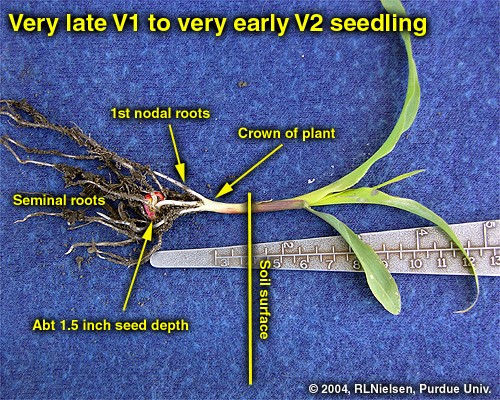
Very late V1 to early V2 corn plant.
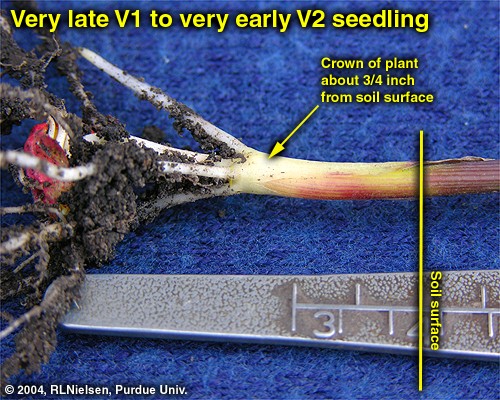
Crown of early V2 plant located about 3/4 inch below soil surface.
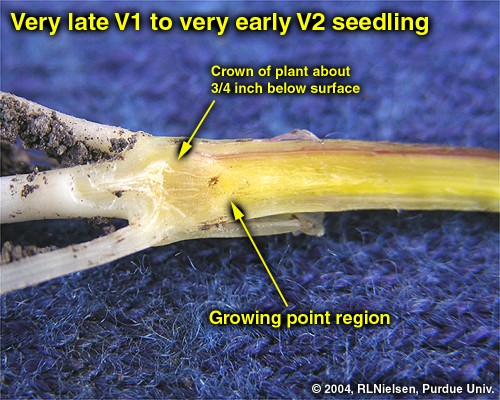
Split stem of early V2 plant, showing growing point.
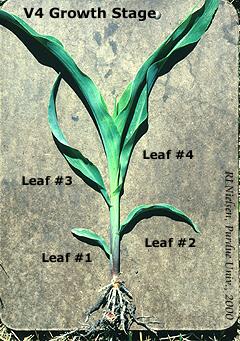
Four leaf collar (V4) corn plant.
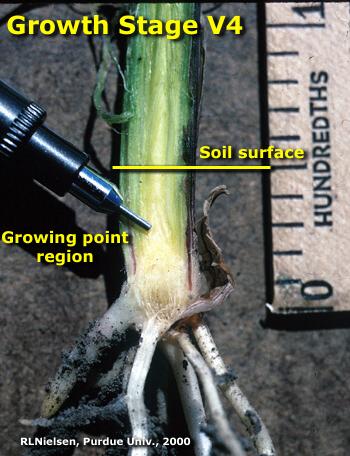
Growing point location within a V4 plant, located near the top of the stalk tissue, of which internode elongation of the latter has only just begun.
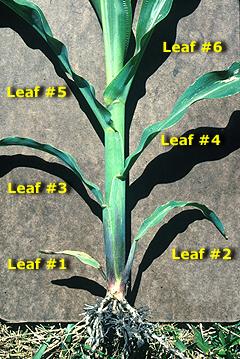
Six leaf collar (V6) corn plant.
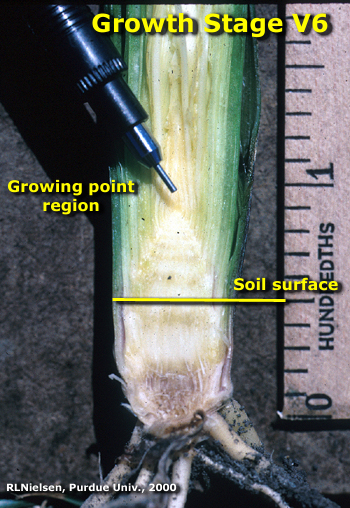
Growing point location within a V6 plant, though technically the growing point no longer exists once it initiates the tassel at about V5.
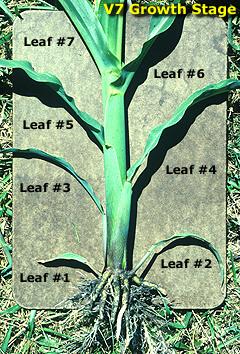
Seven leaf collar (V7) corn plant.
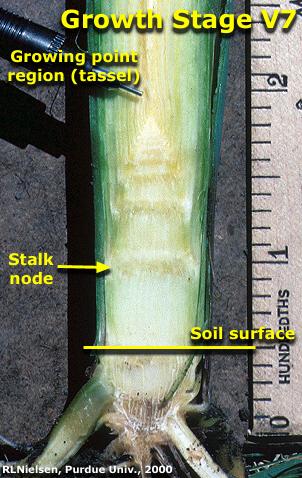
Growing point location within a V7 plant, though technically the growing point no longer exists once it initiates the tassel at about V5.
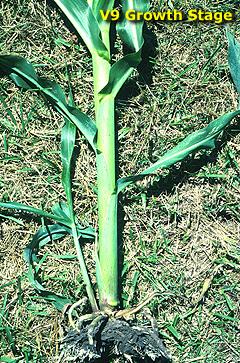
Nine leaf collar (V9) corn plant.
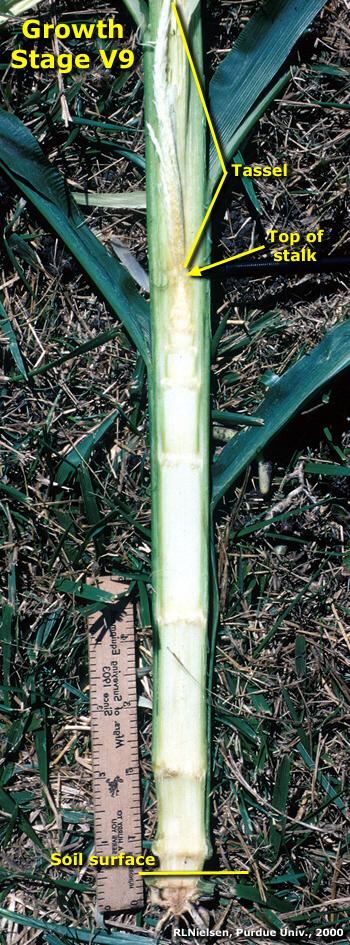
Growing point location within a V9 plant, though technically the growing point no longer exists once it initiates the tassel at about V5.
Nielsen, R.L. (Bob). 2003 (rev.) Estimating Yield and Dollar Returns to Corn Replanting. Purdue Univ. Coop. Ext. Service Pub. No. AY-264-W. http://www.kingcorn.org/pubs/AY-264-W.pdf. [URL accessed May 2019].
Nielsen, R.L. (Bob). 2014. Determining Corn Leaf Stages. Corny News Network, Purdue Univ. http://www.kingcorn.org/news/timeless/VStageMethods.html. [URL accessed May 2019].
Nielsen, R.L. (Bob). 2015. Recovery From Hail Damage to Young Corn. Corny News Network, Purdue Univ. http://www.kingcorn.org/news/timeless/HailDamageYoungCorn.html. [URL accessed May 2019]
Nielsen, R.L. (Bob). 2019. Assessing Frost / Cold Temperature Injury to Young Corn. Corny News Network, Purdue Univ. http://www.kingcorn.org/news/timeless/FrostedCorn.html [URL accessed May 2019]