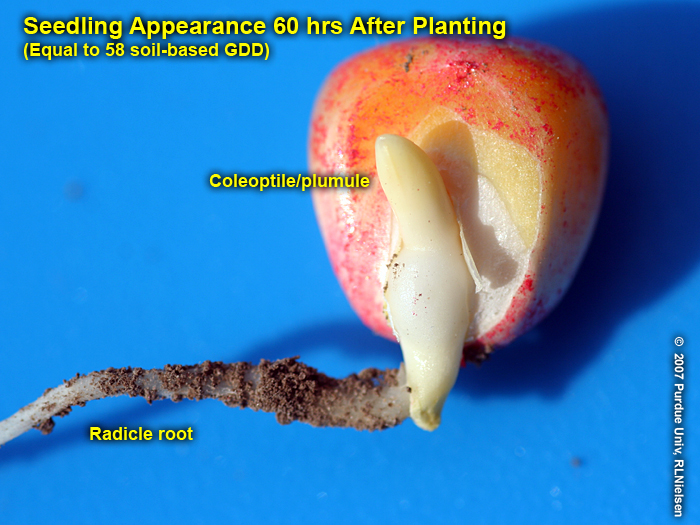
Fig. 1. Radicle root and coleoptile of pre-VE seedling.
Corn is a grass and has a fibrous type root system, as compared to soybeans or alfalfa that have tap root systems. Stunting or restriction of the nodal roots during their initial development (e.g., from excessively dry soil, excessively wet soil, extremely cold soil, insect damage, herbicide damage, sidewall compaction, tillage compaction) can easily stunt the entire plant’s development. In fact, when you are attempting to diagnose the cause of stunted corn early in the season, the first place to begin searching for the culprit is below ground.
To better understand rooting development and problems associated with root restrictions, it is important to recognize that root development in corn occurs in two phases. The first phase is the development of the seminal or seed root system. The second phase is the development of the nodal or crown root system.
Corny Trivia: Sometimes you may hear the seminal root system referred to as the primary root system and the nodal root system as the secondary root system. This classification was described by Cannon (1949) and certainly makes chronological sense. However, in terms of importance to the corn plant, the nodal root system is clearly the primary root system.
Seminal (seed) roots originate from the scutellar node located within the seed embryo. Seminal roots are composed of the radicle and lateral seminal roots. Even though the seminal roots technically are nodal roots, they are traditionally discussed separately from the nodal roots that develop later from the crown area of the seedling.
The radicle root emerges first, rupturing through the seed coat near the tip end of the kernel (Fig. 1) and briefly elongates in that direction regardless whether the kernel tip points up, down, or sideways. The lateral seminal roots emerge later from behind the coleoptile (Fig. 2) and initially elongate toward the dent end of the kernel. However, soon both sets of seminal roots change the orientation of their elongation and begin to elongate downward in response to gravity (Fig. 3).
The seminal root system helps sustain seedling development by virtue of water uptake from the soil, but a young corn seedling depends primarily on the energy reserves of the kernel's starchy endosperm for nourishment until the nodal root system develops later. By about growth stage V1, the rate of new growth by the seminal root system slows down dramatically as the primary nodal root system begins to develop from nodes above the mesocotyl.
Even though the seminal root system contributes little to the season-long maintenance of the corn plant, early damage to the radicle or lateral seminal roots can stunt initial seedling development and delay emergence. Such damage will not necessarily cause immediate death of the seedling as long as the kernel itself and mesocotyl remain healthy, but may result in delayed emergence or the seedling leafing out underground. As more and more nodal roots become established over time, damage to the seminal root system will have less and less impact on seedling survival.
Examples of seminal root damage include imbibitional chilling injury (Nielsen, 2020a), post-germination injury from lethal or sub-lethal cold temperatures (Nielsen, 2020b), and “salt” injury from excessive rates of starter fertilizer placed too close to the kernel. Symptoms of such root damage include retarded root elongation, brown tissue discoloration, prolific root branching, and outright death of root tissue. If the radicle root is damaged severely during its emergence from the kernel, the entire radicle root may die. Once the radicle has elongated a half-inch or so, damage to the root tip will not necessarily kill the entire root, but rather axillary root meristems may initiate extensive root branching in response to damage to the apical meristem.
The images shown in Fig's. 4 - 6 show an example of a delayed emerger in a field where the "normal" emergers were already at late V1 to early V2. The radicle root was completely destroyed, though the lateral seminal roots were intact and healthy. The coleoptile on this seedling was split down the entire length of its side and would likely result in leafing out underground. The split coleoptile was likely due to the natural continued expansion of the enclosed leaves that would have otherwise emerged normally above ground.
The images shown in Fig's. 7 and 8 show another example of a delayed emerger in the same field where other seedlings were late V1 to early V2. The only visible damage to this delayed emerger was its radicle root whose apical meristem had been injured. The damage was less severe than the previous example and so the seedling was less severely stunted and managed to emerge above ground.
Nodal roots develop sequentially from individual nodes above the mesocotyl, beginning with the lowermost node in the area of the young seedling known as the "crown". When the collar of the first leaf first becomes visible, the first set of nodal roots can be identified by a slight swelling at the lowermost node. By late V1, the first set of nodal roots have noticeably begun to elongate (Fig's 9 and 10). By leaf stage V2, the first set of nodal roots are clearly visible and the second set of nodal roots may be starting to elongate from the second node of the seedling. Each set or "whorl" of nodal roots begins to elongate from their respective nodes at about the same timing that each leaf collar emerges from the true whorl of the seedling.
Regarding Seeding Depth & Rooting Depth: Some folks believe that planting corn deeper encourages deeper rooting and vice versa. This belief is mostly myth with a slight hint of truth mixed in. It certainly is true that the depth of the SEMINAL root system is influenced by seeding depth. However, the NODAL root system that develops from the crown of the plant is not influenced much at all by seeding depth. This is because the depth of the crown is fairly constant regardless of seeding depth. During emergence of the seedling, the mesocotyl elongates and elevates the coleoptile and crown towards the soil surface. As the coleoptile nears the soil surface, changes in the ratio of red to far red wavelengths of light causes a change in the supply of one or more growth hormones from the coleoptile to the mesocotyl tissue and mesocotyl elongation consequently comes to a halt (Vanderhoef & Briggs, 1978). Since the depth at which the emerging seedling senses the change in red to far red light is fairly constant, the resulting depth of the crown (base) of the coleoptile is nearly the same (1/2 to 3/4 inch) for seeding depths of one inch or greater.
Elongation of the stalk tissue begins between leaf stages V4 and V5. Elongation of the internode above the fifth node usually elevates the sixth node above ground. Subsequent elongation of higher-numbered stalk internodes will result in higher and higher placement of the remaining stalk nodes. Sets of nodal roots that form at above ground stalk nodes are commonly referred to as “brace” roots, but function identically to those nodal roots that form below ground. If surface soil conditions are favorable (moist and not excessively hot), brace roots will successfully penetrate the soil, proliferate, and effectively scavenge the upper soil layers for water and nutrients.
Corny Trivia: Root hairs are lateral extensions of root epidermal cells, grow to a length of several millimeters, and number about 200 per square millimeter (Gardner et al., 1985). Their typical life span is only about 2 days at moderate temperatures and less so at higher temperatures (Gardner et al., 1985). Root hairs are visible even on the radicle root of a young seedling (Fig. 13). Collectively, the surface area represented by root hairs is very large and can account for a large share of nutrient and moisture uptake by the plant.
Corny Trivia: The primary meristem of a root is located near the root tip (Fig. 14). Elongation of cells behind the meristem leads to elongation of the root.
A split stalk of an older plant will reveal a “woody” or "pithy" triangle of stalk tissue at the bottom of the corn stalk. This triangle is typically comprised of four stalk nodes, stacked sequentially with #1 at the bottom, whose associated internodes do not elongate (Fig. 15). The first internode to elongate is USUALLY the one above the fourth node, which elongates about 1/4 to 1/2 inch, above which is found the fifth node, which is typically still below or just at the soil surface. Consequently, five sets or whorls of nodal roots will usually be detectable below ground, one set for each of the below ground stalk nodes (Fig. 16).
Corn seedlings transition from nutritional dependence on kernel reserves to nutritional dependence on the nodal roots around the V3 leaf stage. Damage or stress to the first few sets of developing nodal roots during the time period V1 to V5 can severely stunt or delay a corn plant’s development. Damage to the first few sets of nodal roots forces the young seedling to continue its dependence on kernel reserves longer than is optimum. If the kernel reserves are nearly exhausted, continued seedling development is easily stunted and seedling death is not uncommon. Typical stresses that can stunt initial nodal development include fertilizer salt injury, seedling diseases, herbicide injury, insect feeding damage, excessively wet or dry soils, soil compaction (tillage or planter).
Starter Fertilizer Note: The success or not of this transition period that occurs around the V3 stage of development greatly influences whether the crop continues to develop strongly and uniformly. It is not uncommon for fields to develop rather uniformly up to about V3 while they are still relying upon kernel reserves. However, sometimes these heretofore uniform stands of corn "fall apart" beyond the V3 stage if nodal root development has been compromised by "crappy" growing conditions and the transition from kernel reserves to nodal root support fails or is less than successful. It is at this stage that starter fertilizer plays a role in ensuring that the transition period occurs successfully. At about V3, one or more of the nodal roots will tap into a starter fertilizer band placed approximately 2 inches to the side and 2 inches below the seed (the proverbial 2x2 placement). Starter fertilizer placed in this position has the advantages over seed-placed starter fertilizer because a) its position relative to nodal root development is more advantageous and b) higher rates of nitrogen and/or potassium can be used without risk of injury to the seed during germination and emergence.
A somewhat uncommon, but dramatic, stunted root symptom is one referred to as the “floppy corn” or “rootless corn” syndrome (Nielsen, 2019a). This problem occurs most commonly as a result of the detrimental effects of excessively dry surface soil near the time of initial nodal root elongation in young (V2 to V4) corn plants. Young nodal roots that emerge from the crown area of the plant will die if their root tips (and associated meristematic areas) desiccate prior to successful root establishment in moist soil. The crown of a young corn plant is typically located only 3/4 inch or so below the soil surface and so is particularly vulnerable to dry upper soil conditions.
Click image to view larger version in a popup window. Left or right arrow on your keypad will cycle through the popup images.
Fig. 1. Radicle root and coleoptile of pre-VE seedling.
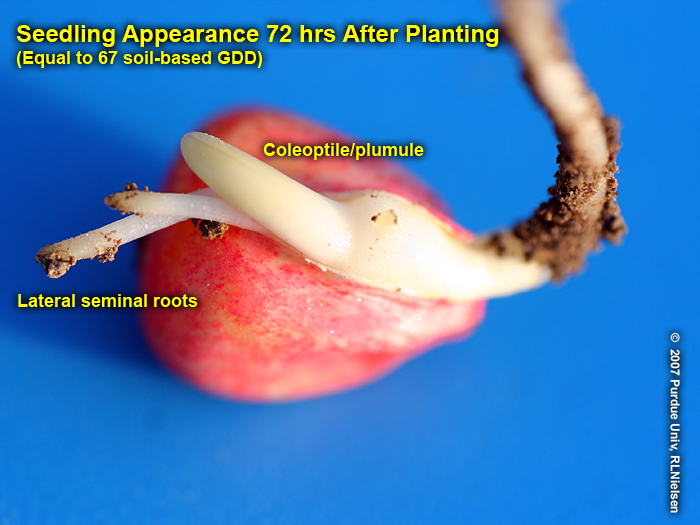
Fig. 2. Lateral seminal roots, coleoptile, and radicle root of pre-VE seedling.

Fig. 3. Seminal root system of VE seedling, but no evidence yet of nodal root system.
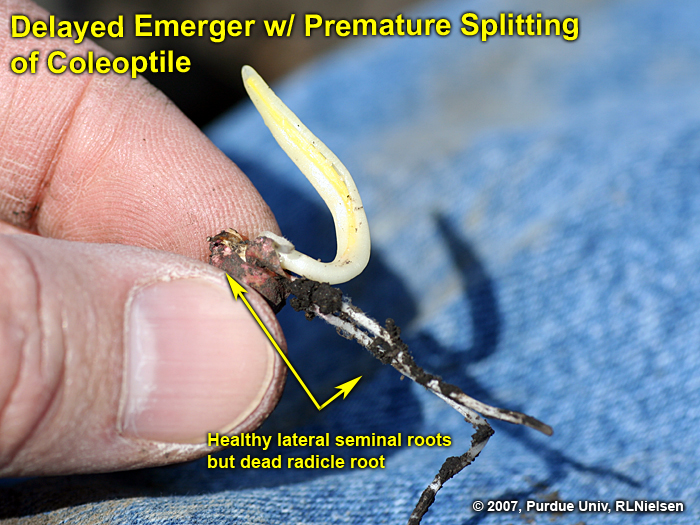
Fig. 4. Delayed emerger w/ healthy lateral seminal roots but damaged radicle root.
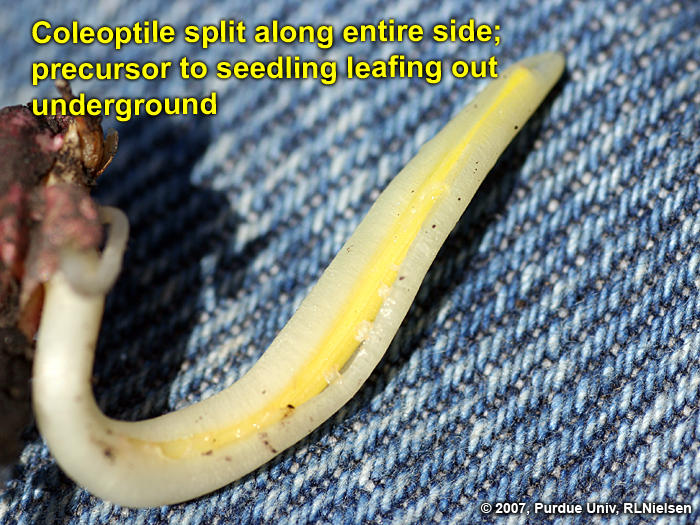
Fig. 5. Split coleoptile; precursor to leafing out underground.
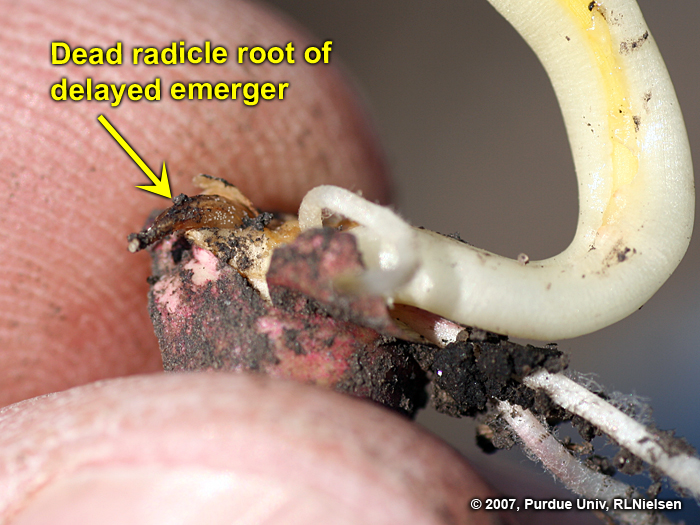
Fig. 6. Dead radicle root on a delayed emerger seedling.
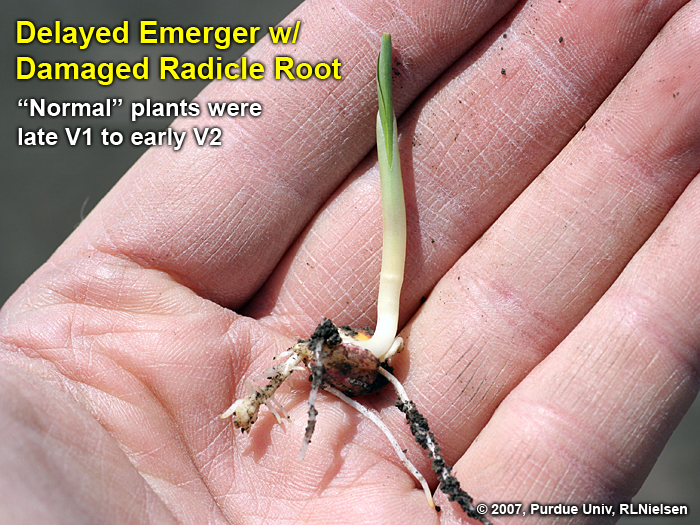
Fig. 7. Delayed emerger with healthy lateral seminal roots and damaged, but alive, radicle root.
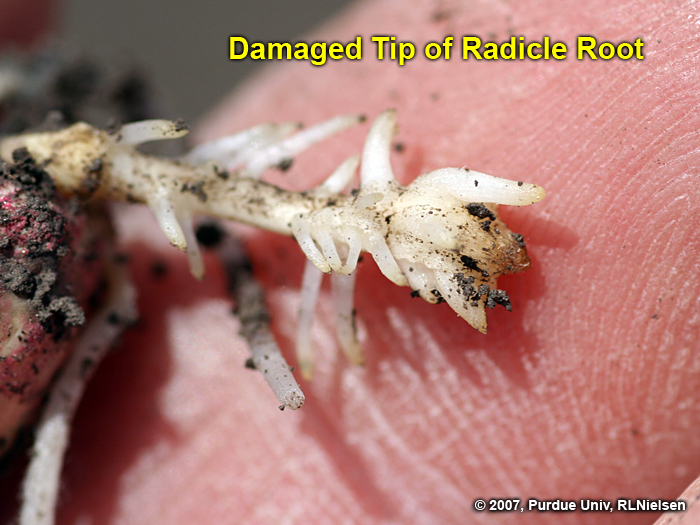
Fig. 8. Closer view of damaged radicle root tip with numerous adventitious roots.
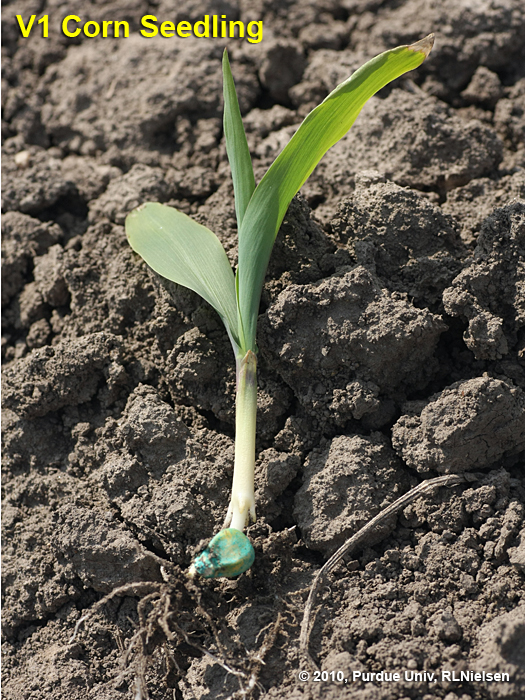
Fig. 9. V1 corn seedling.
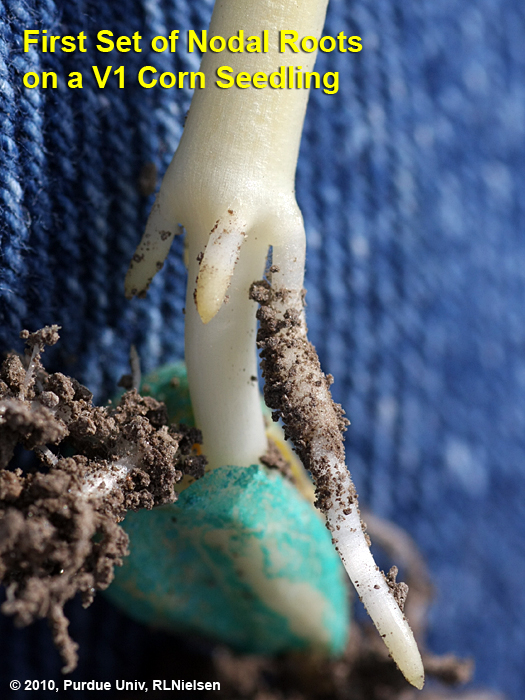
Fig. 10. First set of nodal roots elongating from lowermost node of crown area of V1 corn seedling.
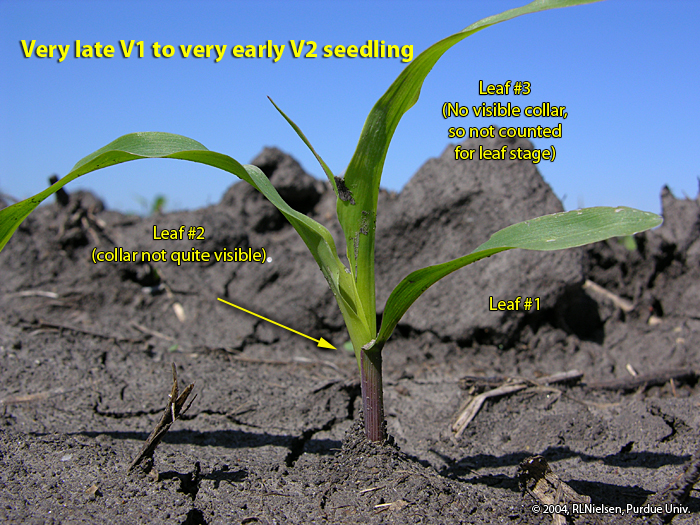
Fig. 11. Late V1 to early V2 corn seedling.
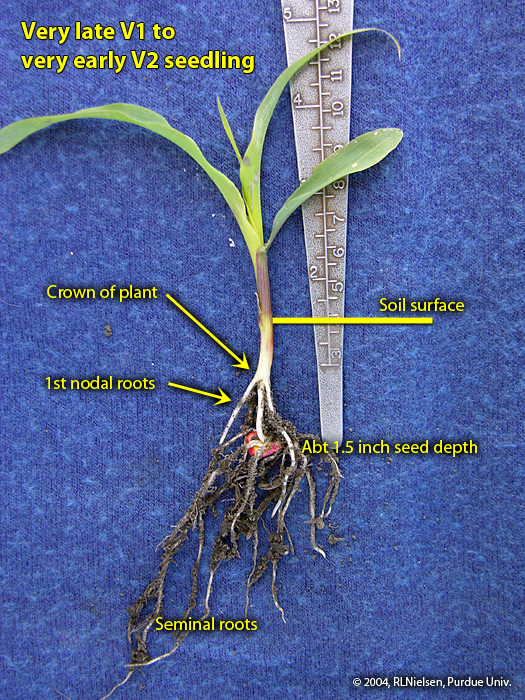
Fig. 12. Seminal and nodal roots of V2 seedling.
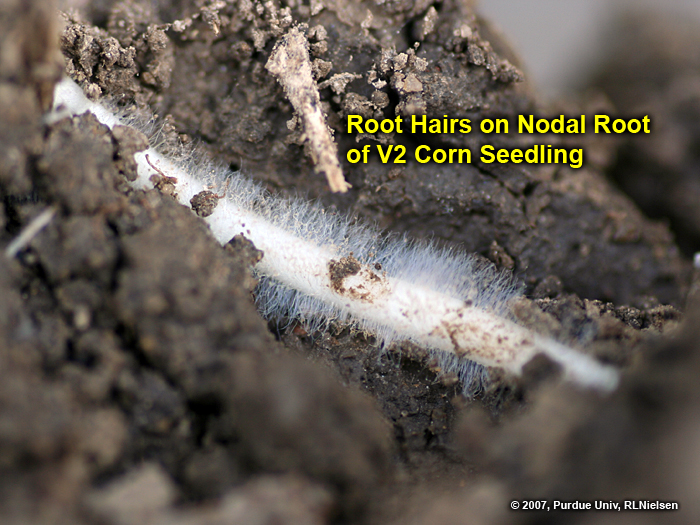
Fig. 13. Root hairs on a V2 corn seedling.
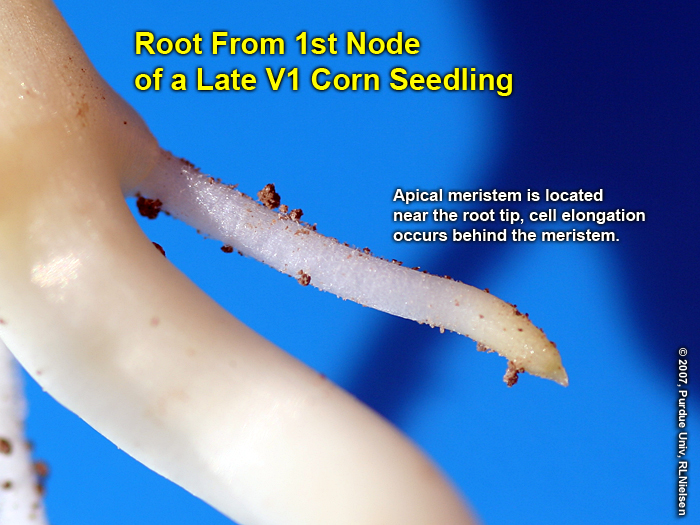
Fig. 14. Apical meristem of root.
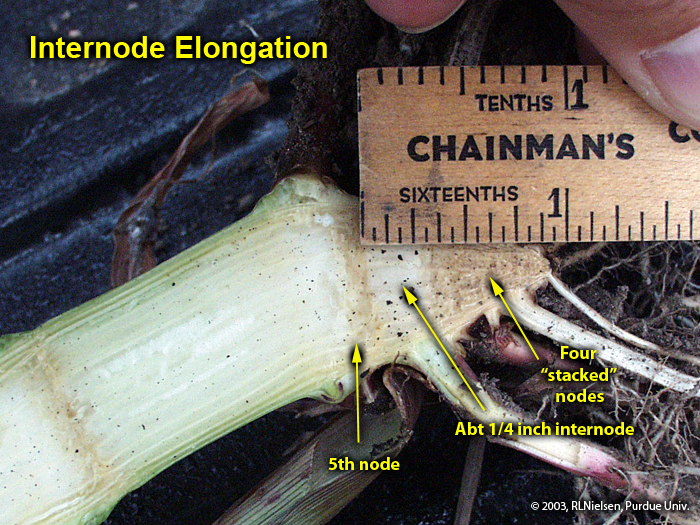
Fig. 15. Internode elongation between fourth and fifth nodes of a corn plant.
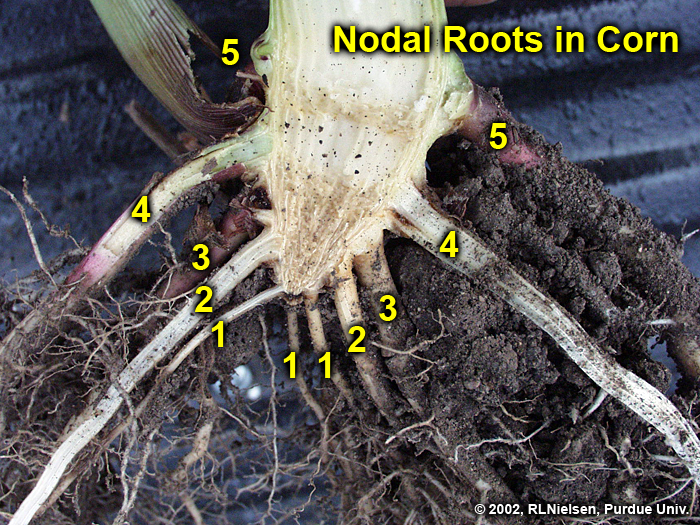
Fig. 16. Five identifiable sets or "whorls" of nodal roots in a split stalk section.
Cannon, William Austin. 1949. A Tentative Classification of Root Systems. Ecology 30[4], 542-548.
Gardner, Franklin P., R. Brent Pearce, and Roger L. Mitchell. 1985. Physiology of Crop Plants. Iowa State Univ. Press, Ames, IA.
Nielsen, RL (Bob). 2019a. Rootless or "Floppy" Corn Syndrome. Corny News Network, Purdue Extension. http://www.kingcorn.org/news/timeless/FloppyCorn.html. [URL accessed Apr 2020].
Nielsen, RL (Bob). 2019b. Visual Indicators of Germination in Corn. Corny News Network, Purdue Extension. http://www.kingcorn.org/news/timeless/GerminationEvents.html. [URL accessed Apr 2020].
Nielsen, RL (Bob). 2020a. Cold Soils & Risk of Imbibitional Chilling Injury in Corn. Corny News Network, Purdue Extension. http://www.kingcorn.org/news/timeless/ImbibitionalChilling.html. [URL accessed Apr 2020].
Nielsen, RL (Bob). 2020b. Emergence Failure of Corn. Corny News Network, Purdue Extension. http://www.kingcorn.org/news/timeless/EmergenceFailure.html. [URL accessed Apr 2020].
Nielsen, RL (Bob). 2020c. The Emergence Process in Corn. Corny News Network, Purdue Extension. http://www.kingcorn.org/news/timeless/Emergence.html. [URL accessed Apr 2020].
Vanderhoef, Larry N. and Winslow R. Briggs. 1978. Red Light-inhibited Mesocotyl Elongation in Maize Seedlings. I. The Auxin Hypothesis. Plant Phys. 61:534-537.