July 2020
URL: http://www.kingcorn.org/news/timeless/Silks.html
Silk Development and Emergence in Corn
R.L. (Bob) Nielsen
Agronomy Dept., Purdue Univ.
West Lafayette, IN 47907-2054
Email address: rnielsen at purdue.edu
Twitter: @PurdueCornGuy
- Corn produces individual male and female flowers on the same plant.
- The ear represents the female flower of the corn plant.
- Severe soil moisture deficits can delay silk emergence and disrupt the synchrony of pollen shed and silk availability, resulting in poor kernel set.
The silks that emerge from the ear shoot are the functional stigmas of the female flowers of a corn plant. Each silk connects to an individual ovule (potential kernel). A given silk must be pollinated in order for the ovule to be fertilized and develop into a kernel. Up to 1000 ovules typically form per ear, even though typically only 400 to 600 actual kernels per ear survive until harvest.
By definition, growth stage R1 (Abendroth et al., 2011) for an individual ear is defined when a single silk strand is visible from the tip of the husk. An entire field is defined as being at growth stage R1 when silks are visible on at least 50 % of the plants. This whole field definition for growth stage R1 is synonymous with the term "mid-silk".
Silk Elongation and Emergence
Silks begin to elongate from the ovules 10 to 14 days prior to growth stage R1 or approximately at the V12 leaf stage. Silk elongation begins first from the basal ovules of the cob, then proceeds sequentially toward the tip of the ear. Because of this acropetal sequence of silk elongation, silks from the basal (butt) portion of the ear typically emerge first from the husk, while the tip silks generally emerge last. Complete silk emergence from an ear generally occurs within four to eight days after the first silks emerge from the husk leaves.
As silks first emerge from the husk, they lengthen as much as 1.5 inches per day for the first day or two, but gradually slow over the next several days. Silk elongation occurs by expansion of existing cells, so elongation rate slows as more and more cells reach maximum size. Elongation of an individual silk stops shortly after pollen is captured, germinates and then penetrates the silk.
If not pollinated, silk elongation stops about 10 days after silk emergence due to senescence of the silk tissue. Unusually long silks can be a diagnostic symptom that the ear was not successfully pollinated (Nielsen, 2018).
Silks remain receptive to pollen grain germination up to 10 days after silk emergence, but to an ever-decreasing degree. The majority of successful ovule fertilization occurs during the first 4 to 5 days after silk emergence (see photos that follow).
Collapse of silk tissue during its natural senescence over time restricts continued growth of the pollen tube. Silk emergence usually occurs in close synchrony with pollen shed, so that duration of silk receptivity is normally not a concern. However, sometimes that synchrony is disrupted by stress. Delay or failure of silks to emerge due to severe drought stress can result in poor kernel set or barren cobs if there is no pollen remaining to be captured by the silks. Some hybrids bred for drought tolerance have very aggressive silk behaviors, meaning that silk elongation is more tolerant of drought conditions. Unfortunately, sometimes under "good" growing conditions, these hybrids silk 4-5 days before any pollen is available. In this situation, the first silks to emerge (generally from near the butt end of the ears) fail to be pollinated, resulting in poor kernel set at the butt end of the cob. See my article on long silks for some photos.
Pollination and Fertilization
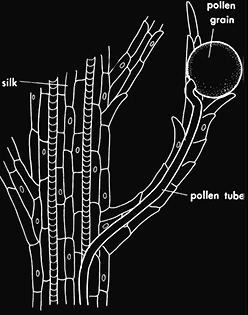 For those of you who are anal about semantics, let's review two definitions relevant to sex in the cornfield. Pollination is the act of transferring the pollen grains to the silks by wind or insects. Fertilization is the union of the male gametes from the pollen with the female gametes from the ovule. Technically, pollination is almost always successful (i.e., the pollen reaches the silks), but unsuccessful fertilization (i.e., pollen tube failure, silk failure, pollen death) will result in poor kernel set and yield losses.
Pollen grain germination occurs within minutes after a pollen grain lands on a receptive silk. A pollen tube, containing the male genetic material, develops and grows inside the silk, and fertilizes the ovule within 24 hours. Pollen grains can land and germinate anywhere along the length of an exposed receptive silk. Many pollen grains may germinate on a receptive silk, but typically only one will successfully fertilize the ovule.
Silk Responses to Severe Stress
Severe Drought Stress. The most common cause of incomplete silk emergence is severe drought stress. Silks have the greatest water content of any corn plant tissue and thus are most sensitive to moisture levels in the plant. Severe moisture deficits will slow silk elongation, causing a delay or failure of silks to emerge from the ear shoot. If the delay is long enough, pollen shed may be almost or completely finished before receptive silks are available; resulting in nearly blank or totally blank cobs.
In addition to causing silk emergence failure, severe drought stress, especially accompanied by high temperatures and low relative humidity, can also desiccate exposed silks and render them non-receptive to pollen germination. In the Eastern Corn Belt, this effect of drought stress on silk receptivity is likely more common than effects on pollen availability or viability.
The severity of drought stress required for significant silk emergence delay or desiccation can probably be characterized by severe leaf rolling that begins early in the morning and continues into the early evening hours. Such severe leaf rolling is often accompanied by an initial change in leaf color from “healthy” green to a grayish-tinged green, before the leaves eventually die.
Silk Clipping by Insects. Severe silk clipping by insects such as corn rootworm beetle or Japanese beetle can interfere with the success of pollination by decreasing or eliminating viable or receptive exposed silk tissue. Fortunately, unless the beetle activity is nonstop for days, continued elongation of silks from inside the husk will expose undamaged and receptive silk tissue at the rate of about one inch or more per day.
Silk "Balling". Occasionally, silks fail to emerge successfully because they fail to elongate in their usual straight "path" from the ovules toward the end of the husk leaves. Instead, silk elongation becomes convoluted (twisted, coiled, scrambled) inside the husk leaves. This silk "balling" phenomenon is not well-understood and hybrids tend to vary in their vulnerability to this type of silk emergence failure. Two different pieces of circumstantial evidence are often associated with the problem. One is a physical restriction imposed on silk elongation caused by unusually"tight" or long husk leaves in certain hybrids. The other circumstance often correlated with silk "balling" is the occurrence of unusually cool nights during the time silk elongation is occurring, but prior to silk emergence. The physiological effect of such cool nights on silk elongation is not understood. It has been years since I last saw a field with a significant level of silk "balling" (Nielsen, 2000).
Related Reading
Abendroth, L.J., R.W Elmore, M.J. Boyer, and S.K. Marlay. 2011. Corn Growth and Development. Iowa State Univ. Extension Publication #PMR-1009. https://store.extension.iastate.edu/Product/Corn-Growth-and-Development [URL accessed July 2020].
Nielsen, RL (Bob). 2000. Scrambled Silks, Anyone?. Corny News Network, Purdue Extension. http://www.kingcorn.org/news/articles.00/SilkBalling-0718.html [URL accessed July 2020].
Nielsen, R.L. (Bob). 2016. A Fast & Accurate Pregnancy Test for Corn. Corny News Network, Purdue Univ. http://www.kingcorn.org/news/timeless/EarShake.html [URL accessed July 2020].
Nielsen, R.L. (Bob). 2020. Tassel Emergence & Pollen Shed. Corny News Network, Purdue Univ. http://www.kingcorn.org/news/timeless/Tassels.html [URL accessed July 2020].
Nielsen, R.L. (Bob). 2018. Unusually Long Silks in Corn. Corny News Network, Purdue Univ. http://www.kingcorn.org/news/timeless/LongSilks.html [URL accessed July 2020]
Purdue Univ. 2014. Corn Rootworms. Entomology Dept, Purdue Univ. http://extension.entm.purdue.edu/fieldcropsipm/insects/corn-rootworms.php [URL accessed July 2020].
Russell, W.A. and A.R. Hallauer. 1980. Corn. (a chapter in) Hybridization of Crop Plants. American Soc. of Agronomy-Crop Science Soc. of America. Madison, WI.
Image Gallery
Click image to view larger version in a popup window. Left or right arrow on your keypad will cycle through the popup images.
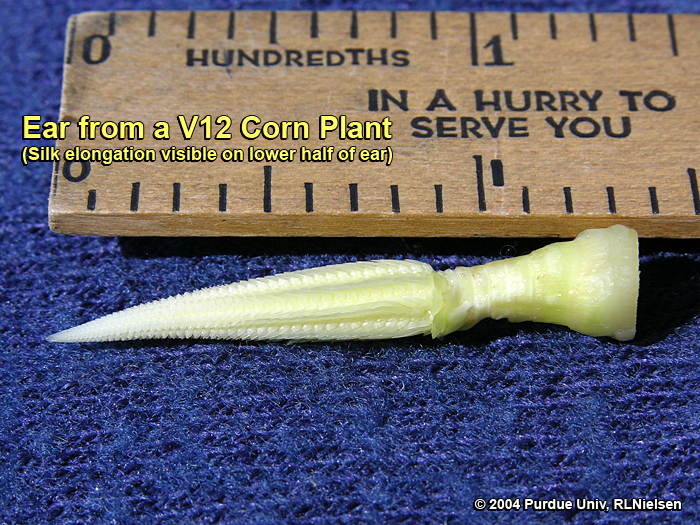
Silk elongation on the lower half of a V12 ear shoot; 10 to 14 days before silk emergence..
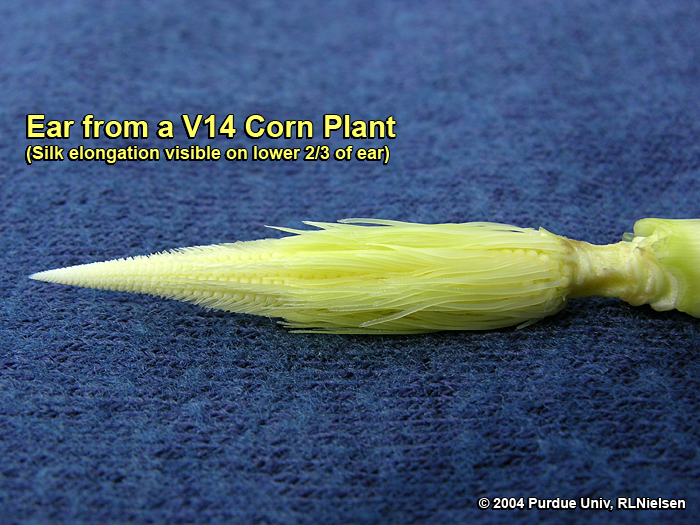
Silk elongation on the lower 2/3 of a V14 ear, about 4 days after V12; 6 to 10 days before silk emergence.
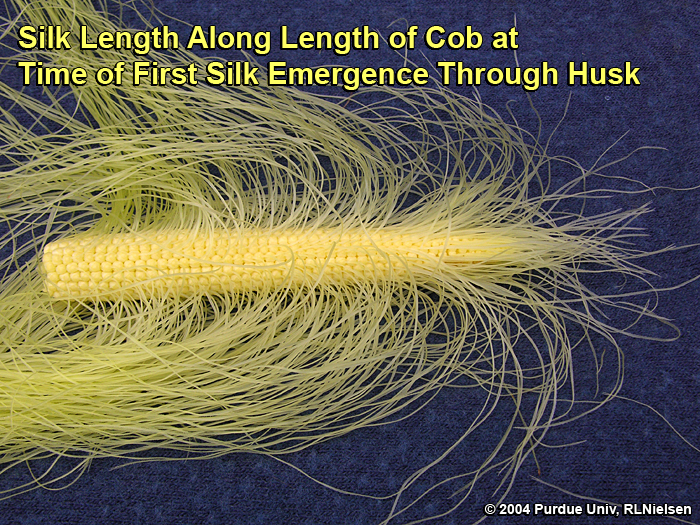
Variable silk length along length of cob at first silk emergence; illustrating the acropetal development of silks.
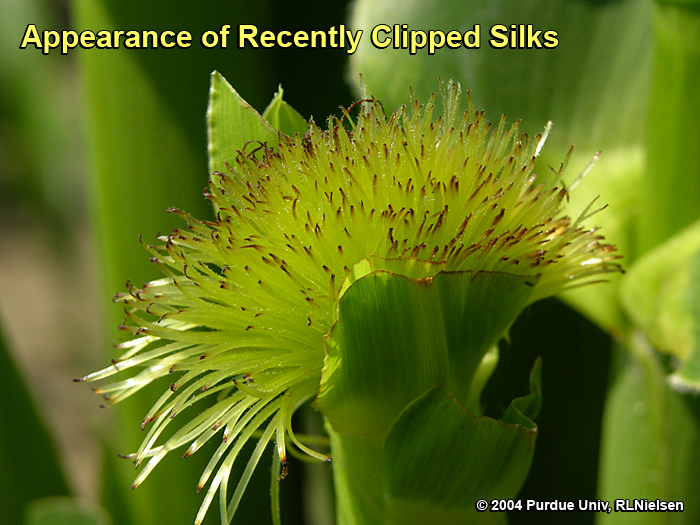
Silks recently clipped with a knife; note the discolored, non-receptive damaged ends of the silks.
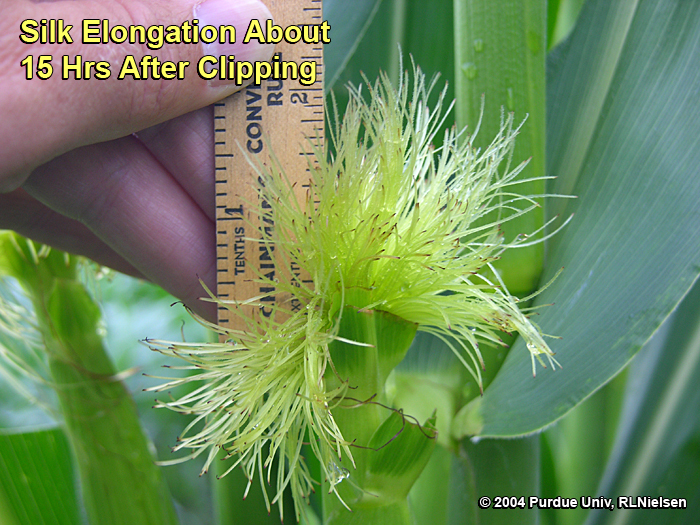
About 1.5 inches of silk elongation since being manually clipped about 15hrs previous.

Western Corn Rootworm beetles (Diabrotica spp.) actively feeding on silks and pollen.
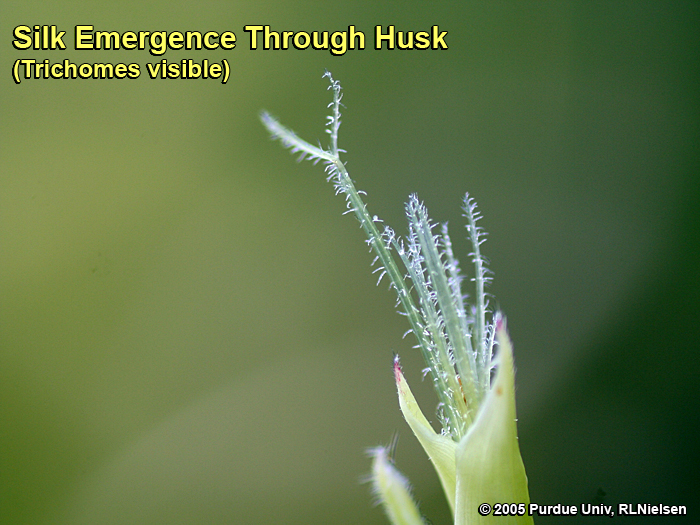
Trichomes visible on silks just emerging through husk leaves.
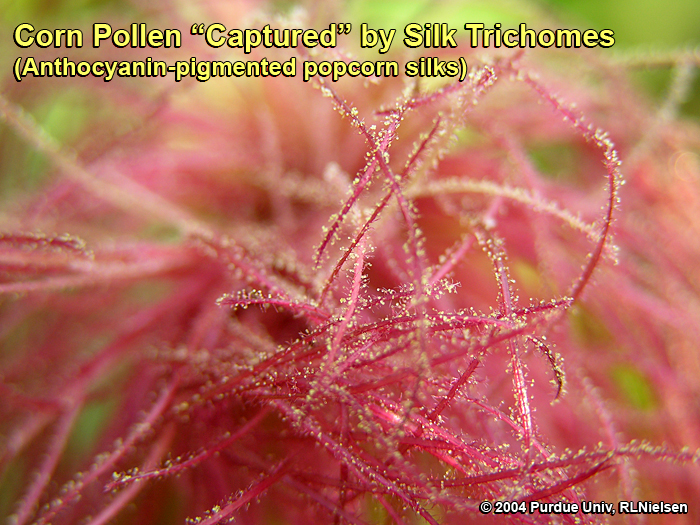
Pollen "captured" by silk trichomes on a popcorn hybrid with anthocyanin-pigmented silks.
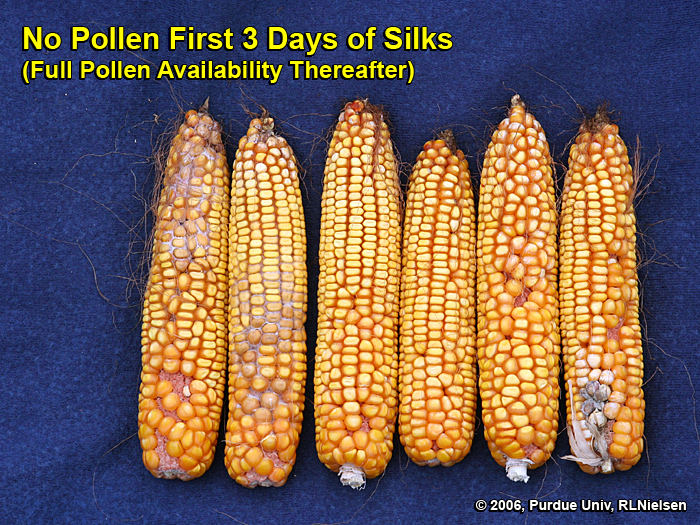
Kernel set on ears where pollination was prevented for 3 days after first silk emergence, then allowed to proceed without interference.
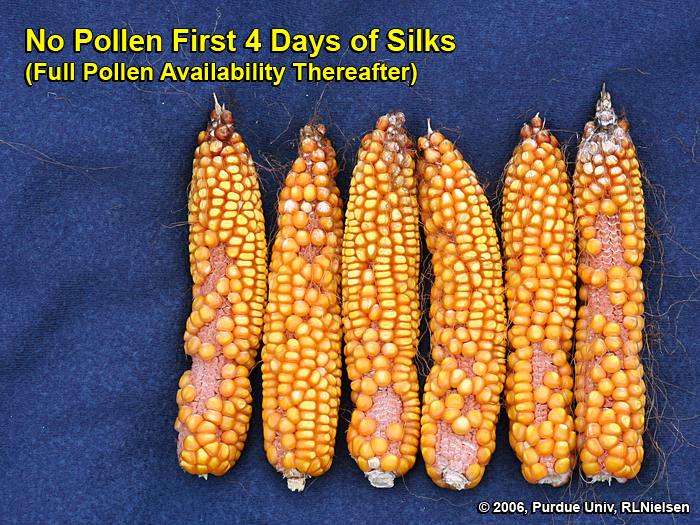
Kernel set on ears where pollination was prevented for 4 days after first silk emergence, then allowed to proceed without interference.

Kernel set on ears where pollination was prevented for 5 days after first silk emergence, then allowed to proceed without interference.