Updated June 2025
URL: http://www.kingcorn.org/news/timeless/PondingYoungCorn.html
Effects of Flooding or Ponding on Corn Prior to Tasseling
R.L. (Bob) Nielsen
Professor Emeritus & Retired Extension Corn Specialist
Agronomy Dept., Purdue Univ.
West Lafayette, IN 47907-2054
Email address: rnielsen at purdue.edu
BOTTOM LINE:
The consequences of flooding, ponding, and saturated soils on young corn depend heavily on the duration of the stress and temperatures.
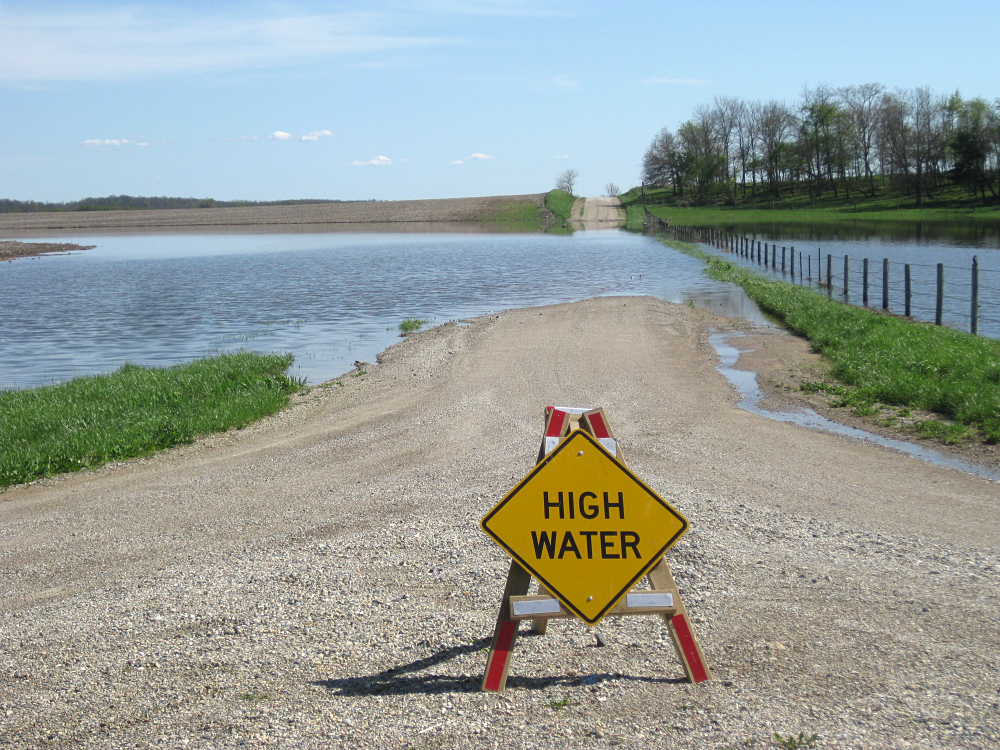
 ntense rainfall events (colloquially referred to as “toad stranglers” or “goose drownders”) flood low-lying corn fields and create ponding (standing water) in poorly drained areas (depressions, compacted soil) within other fields. Other areas within fields, while technically not flooded or ponded, often remain saturated for lengthy periods of time. Recurrent heavy rainfall events simply "add insult to injury" by re-wetting, re-ponding, and re-flooding the same areas of the fields.
What are the prospects for recently submerged corn fields or plants simply enduring days and days of saturated soils? The flippant answer is that suffering crops will survive until they die.
What I really mean is that no one can tell you with certainty the day after the storm whether a ponded area of a corn field will survive or whether there will be long-term yield consequences until enough time has gone by such that you can assess the actual recovery of the damaged plants. We can, however, talk about the factors that increase or decrease the risks of severe damage or death to flooded soils.
Click images to view larger versions in a popup window. Left or right arrow on your keypad will cycle through the popup images.
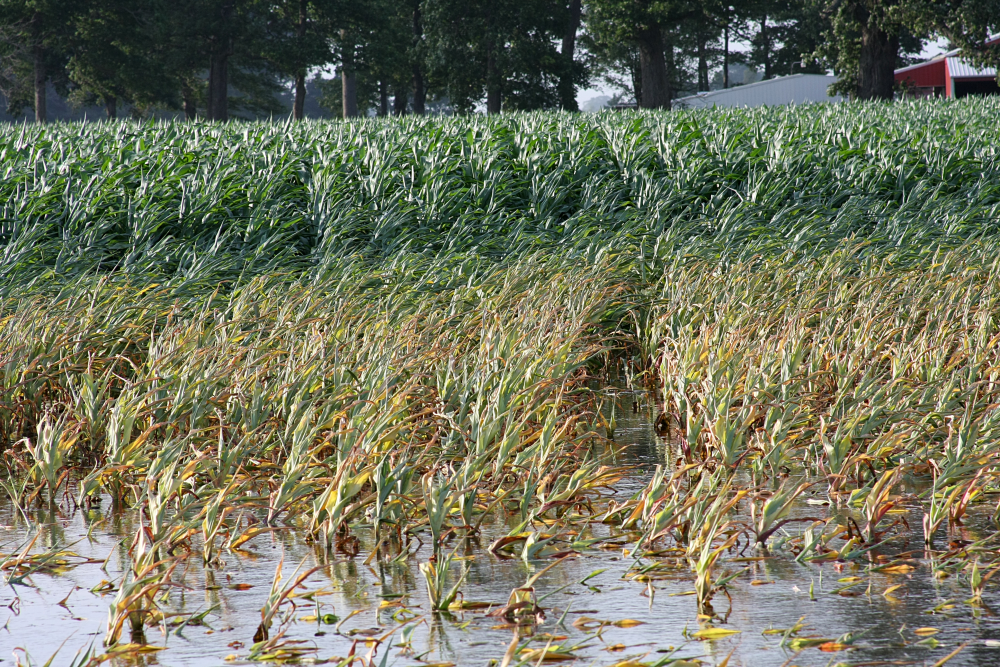
- Plants that are completely submerged are at higher risk than those that are partially submerged.
- Plants that are only partially submerged may continue to photosynthesize, albeit at limited rates.
- The longer an area remains ponded, the higher the risk of plant death.
- Soil oxygen is depleted within about 48 hours of soil saturation. Without oxygen, the plants cannot perform critical life sustaining functions; e.g. nutrient and water uptake is impaired and root growth is inhibited (Wiebold, 2013).
- Many agronomists will tell you that young corn can survive up to about 4 days of outright ponding if temperatures are relatively cool (mid-70's F or cooler); fewer days if temperatures are warm (mid-70's F or warmer).
- Even when surface water subsides quickly, the likelihood of dense surface crusts that form as the soil dries
increases the risk of emergence failure for recently planted crops.
- Be prepared with a rotary hoe to break up the crust and aid emergence. For those "youngsters" among you who do not know how to use a rotary hoe, see Hanna et al. (2001).
- The greater the deposition of mud or old crop residues on plants as the water subsides, the greater the
stress on the plants due to reduced photosynthesis.
- Ironically, such situations would benefit from another rainfall event to wash the mud deposits from the leaves.
- Mud and crud that cakes the leaves and stalks encourage subsequent development of fungal and bacterial diseases in damaged plant tissue. In particular, bacterial ear rot can develop when flood waters rise up to or above the developing ears of corn plants (Nielsen, 2003).
- Corn younger than about V6 (six fully exposed leaf collars) is more susceptible to ponding damage than is corn older than V6.
- This is partly because young plants are more easily submerged than older taller plants and partly because the corn plant's growing point remains below ground until about V6. The health of the growing point can be assessed initially by splitting stalks and visually examining the lower portion of the stem (Nielsen, 2019a). Within 3 to 5 days after water drains from the ponded area, look for the appearance of fresh leaves from the whorls of the plants.
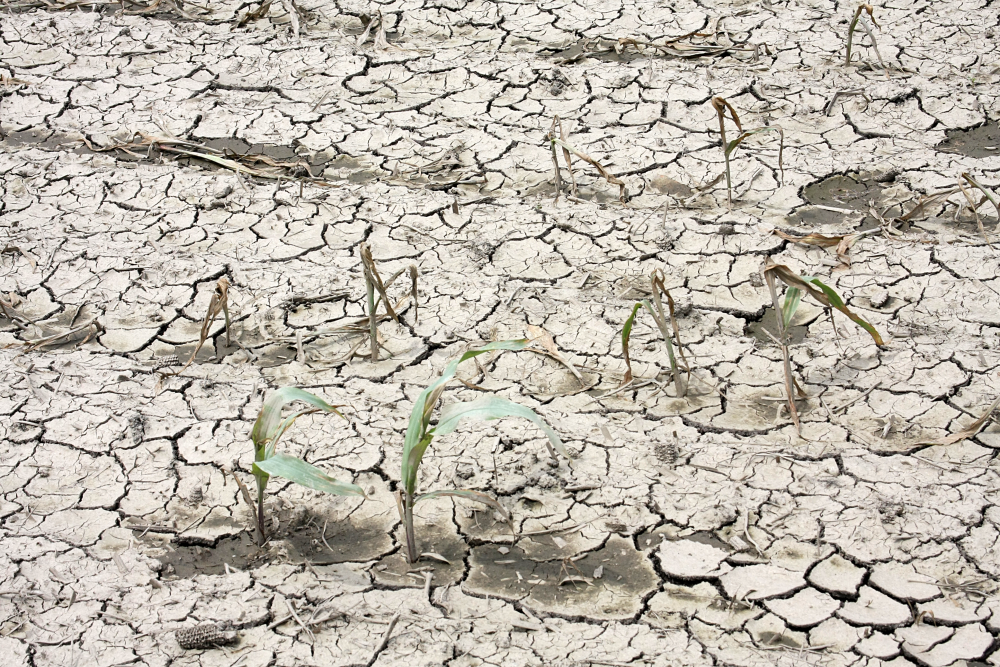
- Extended periods of saturated soils AFTER the surface water subsides will take their toll on the overall vigor of the crop.
- Some root death will occur and new root growth will be stunted until the soil dries to acceptable moisture contents. As a result, plants may be subject to greater injury during a subsequently dry summer due to their restricted root systems.
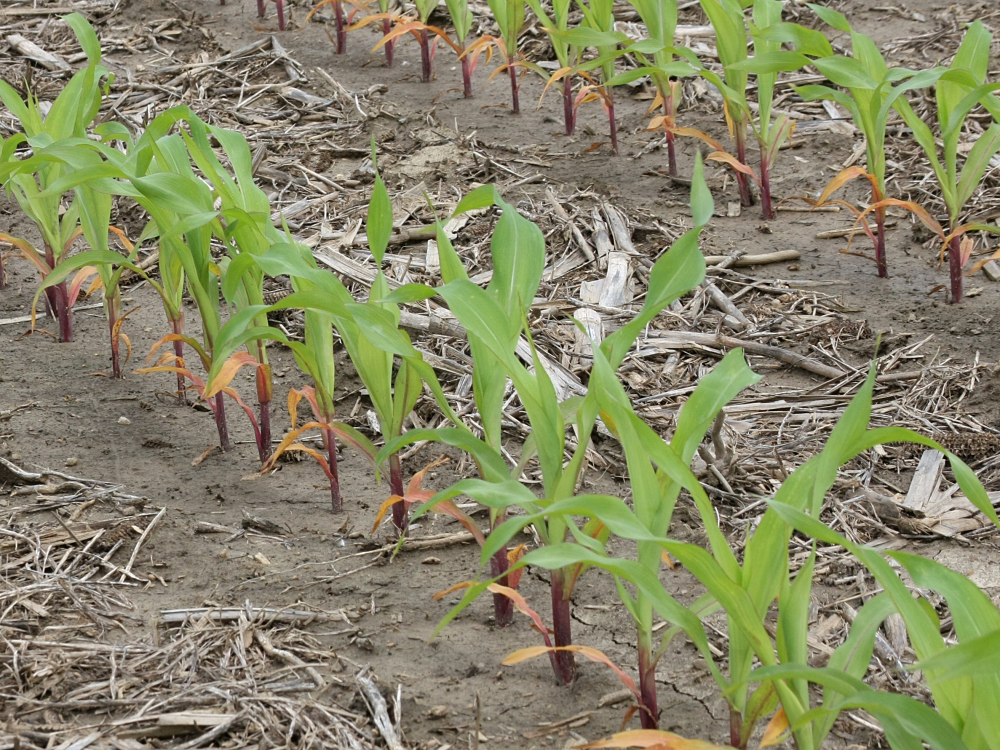
- Nutrients like nitrogen are rapidly remobilized from lower leaves to upper, newer leaves; resulting in a rapid development of orange or yellow lower leaves.
- Because root function in saturated soils deteriorates, less photosynthate is utilized by the root system and more accumulates in the upper plant parts. The higher concentration of photosynthate in the stems and leaves often results in dramatic purpling of those above-ground plant parts (Nielsen, 2022).
- As more of the root system dies, the ability of the affected plants to take up water decreases and, ironically, the plants begin to show signs of drought stress (leaf rolling, plant wilting, leaf death).
- Damage to the root system today will predispose the crop to the development of root and stalk rots later by virtue of the photosynthetic stress imposed by the limited root system during the important grain filling period following pollination. Monitor affected fields later in August and early September for the possible development of stalk rots and modify harvest-timing strategies accordingly.
- Concomitant (I found a new word in the dictionary!) with the direct stress of saturated soils on a corn crop, flooding and ponding can cause significant losses of soil nitrogen (N) from either denitrification of nitrate-N in heavier soils or leaching of nitrate-N in coarser soils (Laboski, 2013). See Camberato and Nielsen (2017) for advice on sampling soils to estimate remaining soil nitrogen.
- Significant loss of soil N will cause nitrogen deficiencies and possible additional yield loss.
- On the other hand, if the corn dies in the ponded areas it probably does not matter how much nitrogen you've lost.
- Lengthy periods of wet soil conditions favor the development of seedling blight diseases in young corn seedlings, especially those caused by Pythium fungi (Sweets, 2015).
- Fungicidal seed treatments effectively protect the seed and seedling for only about 3 weeks after planting. After that, especially if seedling development has been delayed by cold or excessive soil moisture, the risk of infection increases quickly. Fields that looked acceptable one week can be devastated by seedling blight by the next week if conditions are favorable for the disease and seedling development has not yet reached about V3 to V4.
- Poorly drained areas of fields are most at risk for the development of these diseases and so will also be risky for potential replant operations.
- The risk of diseases like common smut and crazy top also increases when soils are saturated or plants are submerged and temperatures are cool (Pataky and Snetselaar, 2006; Jackson-Ziems, 2014).
- The fungus that causes crazy top depends on saturated soil conditions to infect corn seedlings.
- The common smut fungal organism is ubiquitous in soils and can infect young corn plants through tissue damaged by floodwaters. There is limited hybrid resistance to either of these two diseases and predicting damage is difficult until later in the growing season.
- Wind damage to corn during severe storms results in either stalk breakage (aka “green snap”) or root lodging (plants uprooted and laying nearly flat to the ground). The risk of permanent damage is greater during late vegetative development and less with younger plants.
- The yield effect of “green snap” damage depends on the percentage of field affected and whether the stalk breakage occurs above or below the ear, but is usually serious regardless (Licht, 2020). Obviously, stalk breakage below the ear results in zero yield for that plant. Stalk breakage above the ear results in significant yield loss due to the loss of upper canopy photosynthesis capacity for that plant.
- Root lodged corn will recover or straighten up to varying degrees depending on the growth stage of the crop (Nielsen, 2011). Generally, younger corn has a greater ability to straighten up with minimal “goose-necking” than older corn. Yield effects of root lodging depend on whether soil moisture remains adequate for root regeneration, the severity of root damage due to the uprooting nature of root lodging, and the degree of “goose-necking” that develops and its effect on the harvestability of the crop.
Citations and Related Reading
Authors Not Listed. 2019. Seed Decay and Seedling Blight of Corn. Crop Protection Network. EXCELLENT PHOTOS. https://cropprotectionnetwork.org/encyclopedia/seed-decay-and-seedling-blight-of-corn [accessed June 2025].
Brhel, Jenny, Jim Specht, Aaron Nygren, and Nathan Mueller. 2024. Corn and Soybean Survival in Saturated and Flooded Soils. Univ. of Nebraska Cropwatch. https://cropwatch.unl.edu/corn-and-soybean-survival-saturated-and-flooded-soils [accessed June 2025].
Camberato, Jim and RL (Bob) Nielsen. 2017. Soil Sampling to Assess Current Soil N Availability. Corny News Network, Purdue University Extension. http://www.kingcorn.org/news/timeless/AssessAvailableN.html [accessed June 2025]
Ciampiatti, Ignacio, Dorivar Ruiz, and Stu Duncan. 2021. Effect of standing water and saturated soils on corn growth. eUpdate, Kansas State Univ. Extension. https://eupdate.agronomy.ksu.edu/article_new/effect-of-standing-water-and-saturated-soils-on-corn-growth-445-1 [accessed June 2025].
Coulter, Jeff, Seth Naeve, Dean Malvic, and Fabian Fernandez. 2021. Flooded Corn. Univ. Minnesota Extension. https://extension.umn.edu/growing-corn/flooded-corn [accessed June 2025].
Diaz, Dorivar Ruiz and Mary Knapp. 2019. Wet soils and N loss: How much of the applied nitrogen has undergone nitrification?. eUpdate, Kansas State Univ. Extension. https://eupdate.agronomy.ksu.edu/article/wet-soils-and-n-loss-how-much-of-the-applied-nitrogen-has-undergone-nitrification-337 [accessed June 2025].
Elmore, Roger. 2017. Corn Survival in Ponded or Flooded Fields. CropWatch, Univ. of Nebraska. https://cropwatch.unl.edu/2017/corn-survival-saturated-soils [accessed June 2025]
Hanna, Mark, Mahdi Al-Kaisi, and Michael Tidman. 2001. Use the rotary hoe for soil crusting. Integrated Crop Management, Iowa State Univ. Extension. https://crops.extension.iastate.edu/encyclopedia/use-rotary-hoe-soil-crusting [accessed June 2025].
Jackson-Ziems, Tamra. 2014. Corn Diseases: Crazy Top . CropWatch, Univ. of Nebraska Extension. Video at https://youtu.be/1QSTWMEKreM [accessed June 2025].
Jeschke, Mark. 2020. Spring Flooding Damage to Corn. Pioneer Hi-Bred Int'l. https://www.pioneer.com/us/agronomy/Spring-Flooding-Damage-to-Corn.html [accessed June 2025].
Laboski, Carrie. 2013. Potential for Nitrogen Loss Following Heavy Rainfalls. NPK et cetera. Univ of Wisconsin Extension. https://npketc.soils.wisc.edu/2013/06/26/potential-for-nitrogen-loss-following-heavy-rainfalls/ [accessed June 2025].
Licht, Mark. 2020. Greensnap. Iowa State Univ. Extension. https://crops.extension.iastate.edu/encyclopedia/greensnap [accessed June 2025].
Lindsey, Alexander, Marc Sulc, Laura Lindsey, Osler Ortez, and Peter Thomison. Crops Under Water – Crop Stage is Critical for Recovery. C.O.R.N. Newsletter, Ohio State Univ. Extension. https://agcrops.osu.edu/newsletter/corn-newsletter/2022-18/crops-under-water-%E2%80%93-crop-stage-critical-recovery [accessed June 2025].
Luce, Greg. 2019 Corn and Soybean Survival after Flooding. Integrated Pest & Crop Mgmt, Univ of Missouri. https://ipm.missouri.edu/cropPest/2019/5/floodingCornSoybean/ [accessed June 2025]
Miller, Ryan, Liz Stahl, Jeff Coulter, Seth Naeve, Dean Malvick, and Fabian Fernandez. 2024. Continued Rainfall and Excessively Wet Field Conditions. Minnesota Crop News, Univ of Minnesota Extension. https://blog-crop-news.extension.umn.edu/2018/06/continued-rainfall-and-excessively-wet.html [accessed June 2025].
Nielsen, R.L. (Bob). 2003. Bacterial Ear Rot in Corn Due to Flooding. Corny News Network, Purdue Univ. http://www.kingcorn.org/news/articles.03/EarRot-0720.html. [accessed June 2025].
Nielsen, R.L. (Bob). 2011. Prospects of Recovery for Root-Lodged Corn. Corny News Network, Purdue Univ. Extension. https://www.agry.purdue.edu/ext/corn/news/articles.11/FlatCorn-0726.html [accessed June 2025].
Nielsen, RL (Bob). 2019a. Corny Growing Points of Interest. Corny News Network, Purdue Univ. http://www.kingcorn.org/news/timeless/GrowingPoints.html [accessed June 2025].
Nielsen, RL (Bob). 2019b. Determining Corn Leaf Stages. Corny News Network, Purdue Univ. http://www.kingcorn.org/news/timeless/VStageMethods.html [accessed June 2025].
Nielsen, RL (Bob). 2019c. Tips for Staging Corn with Severe Leaf Damage. Corny News Network, Purdue Univ. http://www.kingcorn.org/news/timeless/VStagingTips.html. [accessed June 2025].
Nielsen, RL (Bob). 2019d. Use Thermal Time to Predict Leaf Stage Development in Corn. Corny News Network, Purdue Univ. http://www.kingcorn.org/news/timeless/VStagePrediction.html [accessed June 2025].
Nielsen, RL (Bob). 2022. Prevalent Purple Plants Perennially Puzzle Producers. Corny News Network, Purdue Extension. http://www.kingcorn.org/news/timeless/PurpleCorn.html [accessed June 2025].
Pataky, J. K., and K. M. Snetselaar. 2006. Common smut of corn. The Plant Health Instructor. DOI:10.1094/PHI-I-2006-0927-01. https://www.apsnet.org/edcenter/pdlessons/Pages/CornSmut.aspx [accessed June 2025].
Sweets, Laura. 2015. Seed Decay and Seedling Blights of Corn. Integrated Pest & Crop Management Newsletter, Univ of Missouri Extension. https://ipm.missouri.edu/cropPest/2015/5/Seed-Decay-and-Seedling-Blights-of-Corn/ [accessed June 2025].
Thomison, Peter and Alexander Lindsey. 2018. Impact of ponding and saturated soils on corn. C.O.R.N. Newsletter, Ohio State Extension. https://agcrops.osu.edu/newsletter/corn-newsletter/2018-19/impact-ponding-and-saturated-soils-corn [accessed June 2025].
Timmerman, Amy, Tamra Jackson-Ziems, Roger Elmore, Tyler Williams, and Brian Krienke. 2018. Flooding and Ponding in Corn. CropWatch, Univ Nebr Extension. https://cropwatch.unl.edu/2018/flooding-and-ponding-corn [accessed June 2025].
Wiebold, Bill. 2013. Heavy Rains Exclude Oxygen Needed for Seedling Health from Soils. Integrated Pest & Crop Mgmt, Univ of Missouri. https://ipm.missouri.edu/cropPest/2013/5/Heavy-Rains-Exclude-Oxygen-Needed-for-Seedling-Health-from-Soils/ [accessed June 2025].
Wise, Kiersten. 2021. Crazy Top of Corn. Univ. of Kentucky Extension Plant Pathology Fact Sheet PPFS-AG-C-12. https://plantpathology.ca.uky.edu/files/ppfs-ag-c-12.pdf [accessed June 2025].
Wise, Kiersten. 2025. Diseases That Appear in Ponded Corn. Kentucky Pest News, Univ. of Kentucky Extension. https://kentuckypestnews.wordpress.com/2025/05/13/diseases-that-appear-in-ponded-corn/ [accessed June 2025].
END OF DOCUMENT